On this page
Survey fatigue is one of the biggest barriers to collecting meaningful employee feedback today. When employees are overwhelmed by too many surveys, long questionnaires, or see no action on their input, participation drops, and insights suffer.
To avoid survey fatigue, organizations need smarter strategies:
- Time surveys thoughtfully
- Keep them short and relevant
- Communicate the “why” behind every survey
- Ask clear, non-repetitive questions
- Most importantly — close the loop with visible follow-up
In this blog, we’ll explore what causes survey fatigue, its impact on employee engagement, and practical ways to fix it. Plus, we’ll show how Empuls helps you design surveys that people actually want to take.
What is employee survey fatigue?
Employee survey fatigue is a phenomenon where employees become mentally or emotionally exhausted by the frequency, length, or perceived ineffectiveness of workplace surveys. It results in lower response rates, disengaged participation, and in some cases, complete avoidance of feedback mechanisms.
Today’s organizations rely heavily on surveys to gauge employee engagement, culture, experience, and alignment. But when surveys are overused or poorly executed, they lose their impact. Employees begin to feel like their time and input are being undervalued, especially when there's little follow-up or visible change from previous feedback rounds.
Read the ultimate guide to better workplace surveys!
Effects of survey fatigue
Survey fatigue doesn’t just reduce response rates — it compromises the very purpose of collecting feedback. When employees are overwhelmed or disillusioned with frequent or ineffective surveys, the consequences ripple across your engagement strategy, data integrity, and organizational trust.
1. Decline in participation and completion rates
One of the most immediate signs of fatigue is a noticeable drop in participation. According to the University of New Mexico’s Office of Institutional Analytics, overexposure to surveys can significantly reduce response rates — sometimes to as low as 20–30% in high-frequency environments. That drop not only limits your sample size but also skews your data.
2. Poor data quality and unreliable insights
Fatigued employees are more likely to submit incomplete surveys, select neutral or random responses, or rush through without thoughtful input. This behavior creates misleading trends, especially in longitudinal surveys where accurate baselines are critical.
3. Skewed sentiment due to response bias
When only the most vocal (often dissatisfied) employees respond, while others disengage, it leads to non-response bias. This imbalance can make issues appear more severe or hide silent challenges within the larger employee base.
4. Erosion of trust in feedback systems
When employees repeatedly participate in surveys but don’t see results or action plans, trust begins to erode. McKinsey research highlights that more than 75% of employees say they don’t believe their feedback leads to meaningful change — a key contributor to survey fatigue and disengagement.
5. Culture of apathy and cynicism
Ultimately, fatigue undermines your efforts to build a feedback-first culture. Instead of seeing surveys as a channel to voice opinions, employees begin to treat them as transactional or symbolic, which affects both morale and collaboration.
Multiple studies confirm what many HR leaders intuitively sense: that survey fatigue is real, measurable, and damaging when ignored.
A McKinsey & Company study found that only 28% of employees feel their feedback leads to tangible change, while nearly 40% believe nothing happens after surveys. This disconnect between input and impact is one of the most cited survey fatigue causes across modern workplaces.
The University of New Mexico’s research also highlights that survey fatigue often sets in when respondents receive more than two or three survey requests in a short period — leading to disengagement, skipped questions, or complete drop-off.
Further, a peer-reviewed article in ScienceDirect revealed that lengthy surveys, when combined with repetitive questions, result in a 20%+ decline in cognitive engagement, especially when participants don’t see the relevance or benefit of their effort.
In the healthcare space, NIH-backed research documented a similar trend: patients and employees exposed to multiple feedback instruments showed a gradual but measurable decline in response accuracy — reinforcing the link between over-surveying and poor data quality.
n short, the science is clear: survey fatigue is not about asking questions, it’s about asking too often, without purpose, and without accountability. Let’s go through the survey fatigue types.
5 Types of survey fatigue
Survey fatigue doesn’t always look the same. In some organizations, it’s triggered by survey overload. In others, it stems from inaction, poor design, or repetition. Understanding the types of survey fatigue can help HR leaders and managers tailor their feedback strategy and avoid missteps.
Let’s explore the five most common types:
1. Over-surveying fatigue
This type of fatigue survey stems from frequent survey requests, often without meaningful gaps between them. Employees who are constantly prompted to provide feedback: weekly pulse checks, quarterly culture assessments, post-training reviews, start to view surveys as just another task on their to-do list.
An employee receives three survey invites in two weeks — one for a leadership workshop, another for team engagement, and a third on workplace wellness — without any follow-up or visible outcome. The result? Disengagement and skipped responses.
Survey fatigue cause: Frequency without purpose.
2. Question fatigue
Also known as cognitive fatigue, this occurs when surveys are overloaded with too many questions — particularly ones that are irrelevant, redundant, or poorly framed. Even short surveys can trigger fatigue if they demand too much effort to process.
A 15-minute survey with 60+ questions ranging from detailed policy feedback to open-text narratives can overwhelm employees, leading to rushed or incomplete answers.
Survey fatigue statistics show that longer surveys have drop-off rates as high as 50%, especially after the 20-question mark.
Survey fatigue cause: Overcomplication and mental overload.
3. Long survey fatigue
Different from question fatigue, long survey fatigue relates more to the duration and emotional investment required. Even with fewer questions, if a survey is perceived as tedious or drawn out, employees may lose interest midway.
An annual engagement survey with progress bars that seem stuck or endless matrix-style questions can feel burdensome, resulting in incomplete submissions or abandonment.
Survey fatigue research from ScienceDirect confirms that longer surveys reduce attentiveness, especially when paired with low relevance or generic content.
Survey fatigue cause: Time commitment that feels disproportionate to value.
4. Insincere survey fatigue
This occurs when employees feel that their feedback goes unheard or unused. Over time, this leads to skepticism about whether surveys matter — which becomes one of the leading psychological survey fatigue causes in the workplace.
Employees take part in a detailed engagement survey annually, yet the organization fails to communicate results or action plans. Over time, responses become minimal, vague, or sarcastic.
McKinsey’s survey fatigue statistics reveal that nearly 70% of employees stop participating in surveys if they believe their input won’t drive change.
Survey fatigue cause: Lack of follow-through and leadership accountability.
5. Repetitive survey fatigue
This type arises when employees are asked the same questions over and over across different surveys or teams. It creates a sense of monotony and prompts employees to disengage, even when surveys are short or well-timed.
Monthly pulse surveys that continually ask, “Do you feel valued at work?” without acting on the prior month’s data lead to irritation and apathy.
Survey fatigue research from the University of New Mexico indicates that redundancy in survey design is one of the top drivers of response fatigue and drop-offs.
Survey fatigue cause: Perceived redundancy and lack of personalization.
How to avoid survey fatigue?
Surveys remain one of the most effective tools to capture employee feedback at scale, but only when they’re used with intention. You don’t need fewer surveys. You need smarter ones. By refining your survey methodology, you can avoid survey fatigue, gather better data, and preserve trust.
Here are nine proven strategies to reduce fatigue and drive participation:
1. Optimize survey frequency and timing
One of the most common survey fatigue causes is poor timing. Avoid overlapping with other departments’ feedback cycles, and avoid “survey stacking,” where employees are hit with multiple feedback requests in quick succession.
2. Keep the survey concise
The shorter and more focused your survey, the higher the completion rate. Research from ScienceDirect shows that surveys under five minutes have a 30–40% higher completion rate than longer ones. Too many questions contribute directly to question fatigue, a key type of fatigue survey behavior.
3. Estimate and communicate completion time
Set expectations upfront by stating how long the survey will take. A simple line like “This 3-minute survey helps us improve your work experience” can reduce anxiety and increase participation.
4. Explain the “why” behind the survey
Employees are far more likely to respond if they know why the survey matters. Avoid generic requests. Instead, contextualize each survey with its objective and the impact their responses will have.
This clarity builds psychological safety and counters insincere survey fatigue.
5. Ask relevant questions, in the right order
Avoid double-barreled questions, vague phrasing, or overlapping choices that can confuse respondents and dilute your data. Poorly structured surveys are among the most overlooked survey fatigue causes.
- No overlapping response ranges
- No double negatives
- Use conditional logic to show only relevant questions
- Start with broader themes and end with specifics
6. Limit personal or demographic questions
Too many personal questions — especially upfront — can break trust and increase dropout rates. In fact, survey fatigue statistics show that early demographic questions correlate with up to 15% higher abandonment rates.
If such data is necessary, make it optional or place it at the end with a brief explanation of its purpose.
7. Make the experience visual and engaging
Integrate visuals like emojis, sliders, or branded rating scales to add lightness and reduce survey fatigue. These elements energize users and make the experience feel less transactional and more interactive.
8. Pilot your surveys before launch
Before rolling out a survey to hundreds (or thousands), run it by a small internal group.
- How long did it take?
- Were any questions unclear or repetitive?
- Did any question feel unnecessary or personal?
You’ll uncover usability issues that could otherwise trigger survey fatigue across your wider audience.
9. Use survey templates and best practices
Avoid reinventing the wheel. Using professionally designed templates, like those built into Empuls, ensures a streamlined, fatigue-resistant experience. These templates are built using survey fatigue research to eliminate redundant questions, optimize flow, and boost completion rates.
Empuls’ survey templates are designed to help you listen to your employees, take feedback, and improve your employee experience. If you are looking for any specific template, search and find it instantly.
The benefits of a well-designed survey
Thoughtfully designed surveys do more than gather feedback — they drive clarity, build trust, and create space for action. When you avoid survey fatigue, your surveys become a reliable tool to measure sentiment and shape better employee experiences.
Here’s what a good survey approach delivers:
- Better participation and data quality: Short, well-timed surveys reduce drop-offs and improve response accuracy.
- Higher trust: When employees see their feedback leads to change, they’re more likely to engage in future surveys.
- Actionable insights: Clean, reliable data helps HR and leaders prioritize where to focus their efforts.
Access ready-to-use, research-backed survey templates that simplify design and boost participation. Use these templates to get feedback that matters!
How Empuls helps
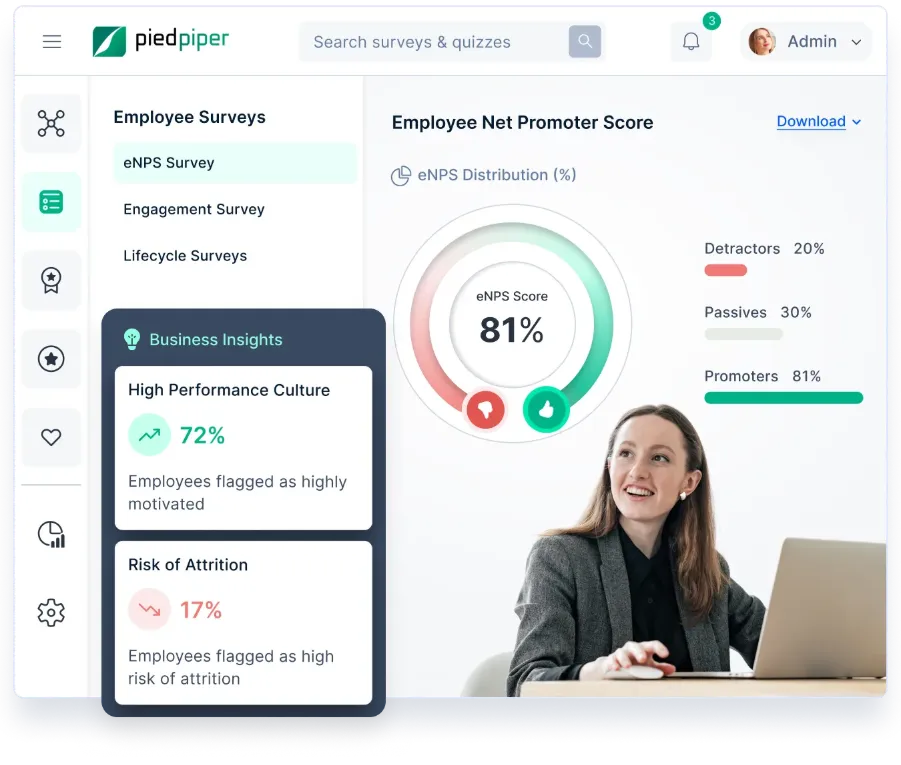
Empuls is built to make employee surveys easier to design, send, and act on, without overwhelming your workforce.
- Smart scheduling: AI-powered nudges ensure surveys don’t clash with other comms or overload employees.
- Ready-to-use templates: Choose from science-backed templates for engagement, pulse, eNPS, and more.
- Survey insights: Understand participation trends, sentiment, and areas of improvement in real time.
- In-flow responses: Employees can take surveys inside tools they already use — like Slack or Teams.
- Follow-through made simple: Empuls helps you close the loop with built-in action planning and updates.
By removing the common causes of survey fatigue, over-surveying, long forms, lack of follow-up, Empuls helps you run surveys people actually want to take.
Our experts are here to help, from survey frameworks to action planning.
Get expert advice on your survey strategy!
Conclusion
Survey fatigue isn’t just a response problem — it’s a design problem. When surveys are frequent, long, or poorly followed up, employees stop engaging. But with the right structure, timing, and tools, surveys can become powerful drivers of culture and clarity.
Empuls helps you move from feedback overload to feedback impact — with smart nudges, science-backed templates, and built-in action plans. The result? Higher response rates, better insights, and a workforce that feels heard.
FAQ's
1. What are the 4 common errors in surveys?
The four common errors in surveys are:
- Coverage error: Not reaching the right target audience.
- Sampling error: Choosing a sample that doesn’t represent the population.
- Measurement error: Poorly worded or confusing questions.
- Nonresponse error: Skewed data due to low or biased participation.
2. What is another word for survey fatigue?
Survey fatigue is also referred to as respondent fatigue or questionnaire fatigue. It describes the mental exhaustion or disengagement people feel when overexposed to surveys.
3. Why does survey fatigue happen?
Survey fatigue happens when employees are asked to complete too many surveys, when surveys are too long or repetitive, or when they don’t see any follow-up action. It’s a direct result of poor planning, lack of personalization, and broken feedback loops.