On this page
A high-performing workforce doesn’t happen by accident — it’s built on systems that recognize effort, reward outcomes, and reinforce what success looks like. That’s exactly what a performance management and reward system enables. It bridges the gap between strategy and execution by turning recognition into a driver of results.
When implemented well, a reward system for employees doesn’t just track performance — it transforms it. It can:
- Aligns individual goals with business outcomes
- Increases productivity, accountability, and engagement
- Reduces attrition and retains top performers
- Reinforces company culture and values
- Encourages continuous improvement and transparency
Whether you're building a framework from scratch or revamping your current process, this blog will guide you through:
- How incentives and rewards contribute to organizational success
- Its benefits
- Key components
- Step-by-step guide to implementing one using Empuls
- Best practices from top HR experts
- Challenges and practical solutions backed by data
- FAQs to address common queries on performance rewards
Let’s explore how you can turn your recognition strategy into a true business advantage.
How incentives and rewards contribute to organizational success
A well-structured performance management and reward system reinforces the behaviors and outcomes that matter most. According to the University of Minnesota’s HR guidance, effective rewards should be timely, performance-based, and aligned with organizational goals, key principles that ensure fairness, motivation, and strategic alignment across teams.
Let’s look at how this plays out across business metrics:
1. Boosts employee engagement and motivation
A strong reward system in performance management activates the psychological contract between employer and employee. Recognition for achieving performance goals makes employees feel valued, which leads to greater commitment. SHRM reports that organizations that connect rewards to performance see up to a 50% increase in employee motivation and discretionary effort.
2. Drives retention and reduces attrition
High-performing employees stay where they’re seen, appreciated, and rewarded. Forbes research reveals that companies that align recognition with performance experience 31% lower voluntary turnover compared to those that don’t. This underscores the value of implementing structured, fair, and frequent performance-based recognition.
3. Improves team and organizational productivity
When incentives are tied to clear KPIs, they drive focus, urgency, and accountability. Microsoft’s integration of rewards with performance metrics resulted in a measurable 20% improvement in productivity across departments.
4. Reinforces company culture and values
A good performance management reward system doesn’t just reward outcomes — it celebrates how those outcomes are achieved. By integrating value-based awards (e.g., for collaboration, innovation, or integrity), organizations reinforce cultural behaviors and build consistency across global teams.
Benefits of a performance management reward system
A strategically designed performance management and reward system serves as a growth engine — not just for individuals but for the entire organization. When implemented with intention and intelligence, it creates a win-win: employees feel seen and supported, while businesses experience tangible performance gains.
Here are the top benefits that HR leaders and CHROs can expect:
1. Stronger alignment between individual goals and business objectives
When performance targets are clearly linked to rewards, employees naturally align their focus with organizational priorities. This alignment enhances goal clarity and drives accountability. The University of Minnesota HR Center confirms that goal-linked rewards amplify employee contributions by reinforcing desirable behaviors in real-time.
2. Increased productivity and employee output
A well-integrated reward system in performance management motivates employees to go beyond baseline expectations. According to Microsoft’s HR insights, aligning incentives with outcome-based performance led to a 20% rise in productivity and 12% better cross-functional collaboration across their global teams.
3. Enhanced engagement and job satisfaction
Recognition and rewards are key drivers of emotional engagement. The Forbes Human Resources Council found that companies with formalized recognition programs see a 14% increase in employee engagement, a direct outcome of performance being valued and celebrated.
4. Lower attrition and higher retention of top performers
When high achievers are consistently recognized and rewarded, they are more likely to stay. A performance-driven reward culture reduces flight risk and builds loyalty. SHRM reports a 31% decrease in turnover for organizations that have embedded recognition into their performance management practices (SHRM & Microsoft).
5. Improved talent development and succession planning
By identifying and rewarding skills that drive performance — such as leadership, innovation, or adaptability — HR can create structured pathways for advancement. Tools like AI-based skill mapping and performance dashboards, such as those available in Empuls, help HR make data-informed decisions on promotions, development needs, and workforce planning.
Let’s walk you through how Empuls is transforming recognition for 1000+ organizations globally.
Schedule a quick discovery call →
Key components of an effective performance management reward system
A successful performance management and reward system is built on a strong foundation of structure, transparency, and strategic alignment. Here are the essential components HR leaders must include:
- Clear performance metrics: Define measurable goals linked to business outcomes and employee roles.
- Regular feedback loops: Enable ongoing performance conversations, not just annual reviews.
- Recognition mechanisms: Integrate spot, peer-to-peer, and value-based recognition for timely reinforcement.
- Reward personalization: Offer diverse, meaningful rewards — from points and gift cards to experiences and wellness perks.
- Automation & integration: Use technology to sync with HRMS/PMS systems for seamless execution.
- Governance & fairness: Ensure transparency, approval workflows, and prevent reward bias or abuse.
When these components come together, they form a reward system for employees that’s not only equitable but also deeply motivational.
Best practices for performance management and reward system
To ensure long-term success and adoption of your performance management and reward system, here are proven best practices:
- Link rewards to outcomes, not just effort: Focus on rewarding results that align with business goals, ensuring a merit-based culture.
- Ensure transparency and fairness: Define clear criteria and communicate them to employees to avoid ambiguity or perceived bias.
- Incorporate peer feedback: Include 360° feedback and manager insights to get a holistic view of performance.
- Leverage data and insights: Use analytics to spot recognition gaps, track participation, and fine-tune your reward system for employees.
- Keep rewards timely: Recognize achievements in real time to reinforce the desired behaviors when they matter most.
- Balance monetary and non-monetary rewards: Blend tangible incentives with public recognition and growth opportunities.
These practices create a system that motivates, engages, and retains — rather than one that merely evaluates. Now that we have covered the best practices, let’s learn how to implement it.
Steps to implement a performance management and reward system with Empuls
Building a performance-linked rewards framework doesn’t have to be complex — especially with a platform like Empuls that brings automation, personalization, and AI-powered insights under one roof.
Step 1: Define performance goals and outcomes
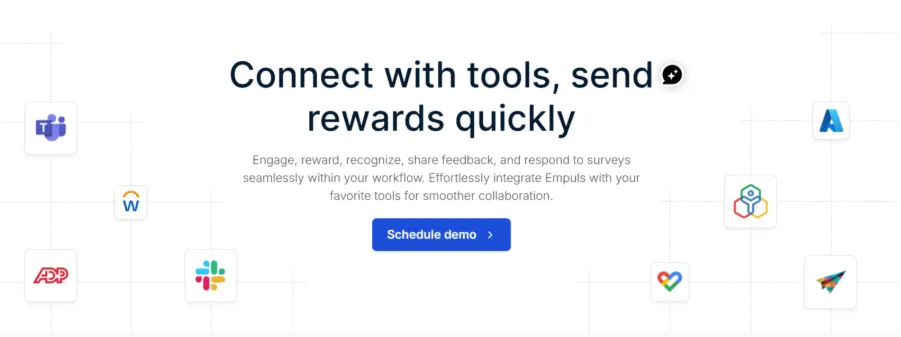
Start by aligning individual, team, and organizational KPIs. Empuls integrates directly with your Performance Management System (PMS) to tie these goals to reward triggers.
Step 2: Design your reward framework
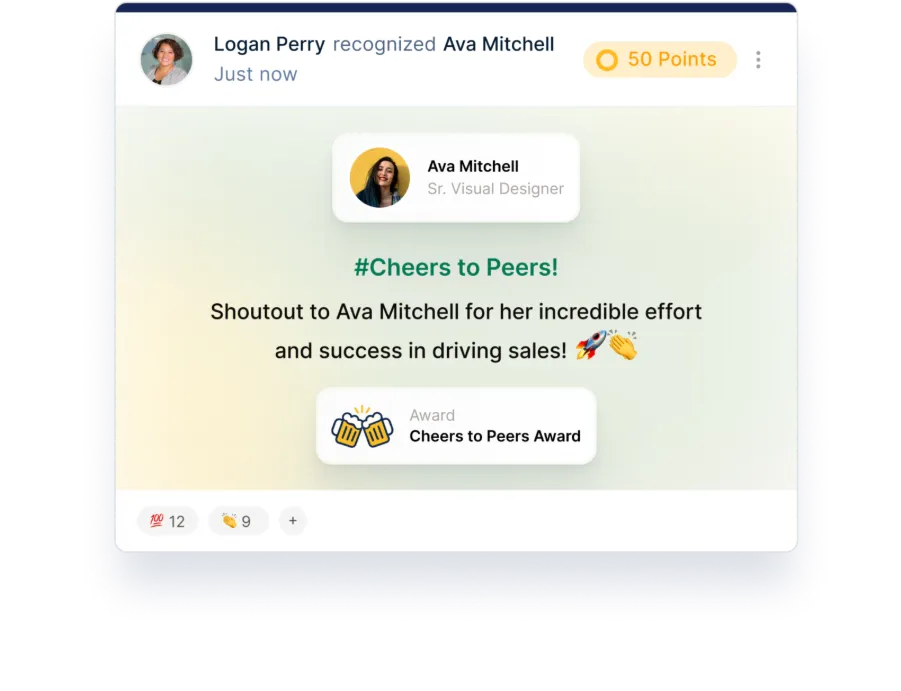
Use Empuls to set up spot, nomination-based, jury, or peer-to-peer awards. With built-in templates, budget controls, and COLI adjustments, you can tailor your reward system in performance management to match your org structure and budget needs.
Step 3: Automate recognition cycles
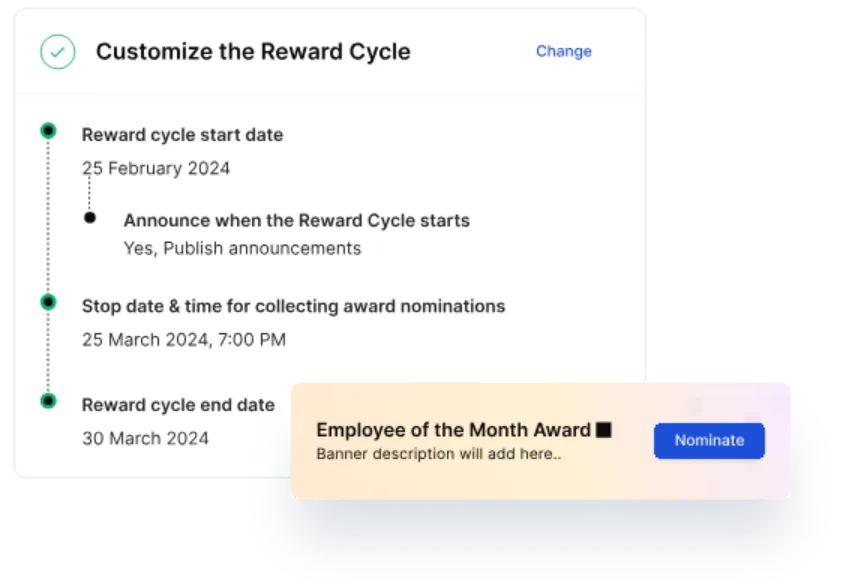
Automate performance-linked recognition via Empuls’ rule-based workflows. Whether it’s monthly performance awards or quarterly excellence cycles, Empuls lets you set start/end dates, approval paths, and auto-notifications.
Step 4: Personalize rewards
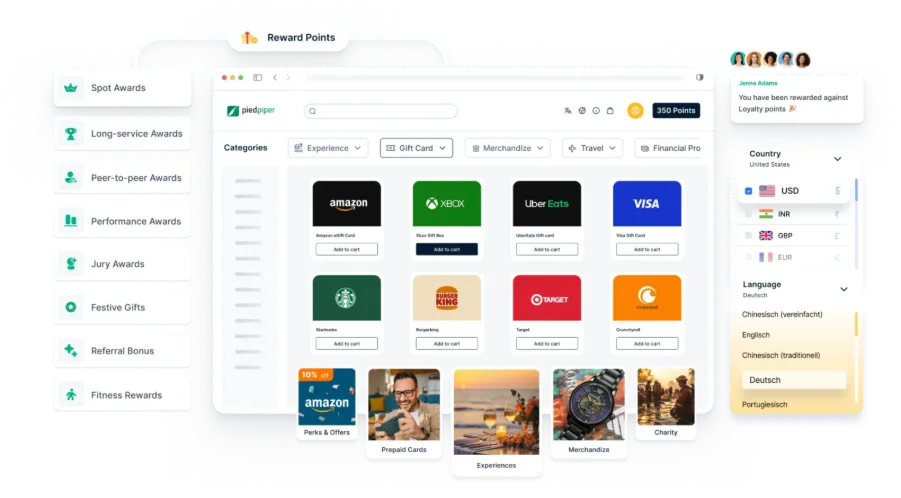
Let employees redeem from a global catalog of 10M+ options, including experiences, gift cards, wellness perks, and custom swag — all through Empuls’ unified reward store.
Step 5: Track impact and optimize
Monitor the effectiveness of your performance management reward system with Empuls’ intuitive dashboards. View participation rates, reward distribution, and manager impact scores to refine your program continuously.
Download our free guide on Implementing a Reward and Recognition Program to get actionable templates, best practices, and rollout frameworks used by top HR teams
Challenges and solutions in implementing a performance management and reward system
Even the most thoughtfully designed performance management reward system can face roadblocks. Recognizing these early — and solving them with the right tools — ensures sustainable success.
Challenge 1: Inconsistent recognition across teams
Without a structured framework, recognition becomes sporadic and biased.
Solution: Use Empuls to automate award workflows, set approval hierarchies, and surface recognition gaps using AI-powered nudges.
Challenge 2: Misalignment between rewards and performance
Generic rewards that don’t reflect employee contributions diminish the impact of the program.
Solution: Tie rewards directly to KPIs and core values. Empuls’ PMS integrations and smart award templates ensure contextual, performance-linked recognition.
Challenge 3: Manual program management and poor visibility
Spreadsheets and emails can’t scale recognition in large or distributed teams.
Solution: Empuls offers a centralized dashboard to manage, automate, and report on all reward programs — with real-time insights on adoption, budget, and ROI.
Challenge 4: One-size-fits-all rewards
Not all employees are motivated by the same rewards.
Solution: Empuls’ global reward marketplace offers over 10 million redemption choices across 100+ countries — ensuring personalization at scale.
Challenge 5: Low adoption and engagement
Even great systems fail without awareness and usability.
Solution: With Empuls integrated into Microsoft Teams, Slack, and mobile, employees can give and receive recognition in their natural flow of work.
Conclusion
A high-impact performance management and reward system is more than just a tool to assess outcomes — it’s a strategic framework to inspire excellence, foster engagement, and retain top talent. In a competitive, hybrid-first world, aligning performance metrics with meaningful, personalized rewards isn’t just smart — it’s necessary.
Empuls enables HR leaders and CHROs to implement a reward system for employees that’s automated, personalized, and integrated into daily workflows. With the right mix of technology and behavioral insight, you can turn recognition into a business advantage.
Talk to our culture experts and explore how Empuls can help you build a scalable, global recognition framework with automation, insights, and impact.
FAQs
What is a reward system in performance management?
A reward system in performance management refers to the structured process of recognizing and rewarding employees based on their performance, achievements, and alignment with company goals. It includes both monetary (bonuses, incentives) and non-monetary rewards (recognition, career development) aimed at motivating and retaining talent.
What are the four types of reward systems?
The four main types of reward systems are:
- Monetary rewards – Bonuses, salary increases, profit-sharing.
- Non-monetary rewards – Public recognition, awards, extra time off.
- Intrinsic rewards – Personal growth, learning opportunities.
- Extrinsic rewards – Tangible items like gift cards, promotions, or physical gifts.
What are the 5 C's of performance management?
The 5 C’s that define effective performance management are:
- Clarity – Clear goals and expectations.
- Consistency – Regular evaluations and feedback.
- Collaboration – Manager-employee alignment.
- Communication – Open channels for feedback and recognition.
- Continuous improvement – Iterative feedback loops and development plans.
What are the 4 stages of performance management?
The four key stages of the performance management cycle are:
- Planning – Setting goals and expectations.
- Monitoring – Tracking progress and providing feedback.
- Reviewing – Evaluating performance over time.
- Rewarding – Recognizing and compensating performance outcomes.