

On this page
The SalesTech industry has evolved from basic contact management systems to comprehensive revenue intelligence platforms powered by AI and predictive analytics. Yet, as products become feature-rich and competitors multiply, differentiation no longer comes from features alone—it comes from how effectively SalesTech companies engage every stakeholder in their ecosystem.
The numbers tell a compelling story:
- Sales rep turnover averages 35% annually, making intuitive, easy-to-adopt tools absolutely critical for onboarding efficiency
- Channel and reseller partnerships drive 40-50% of SalesTech revenue, yet most remain under-engaged without transparent incentive tracking
- Sales cycles stretch to 60-120 days for enterprise deals requiring sustained motivation across complex buying committees
- Feature adoption remains low with sales teams using only 35-45% of available capabilities, limiting perceived platform ROI
- CS teams manage customer portfolios without structured recognition tied to user adoption, pipeline impact, and retention outcomes
The truth: SalesTech companies can't scale without purposeful engagement across customer sales organizations, channel partners, internal sales teams, CS teams, end users, and internal employees.
Understanding the competitive landscape helps contextualize why engagement matters so much in this quota-driven, performance-obsessed market.
Major SalesTech companies across key regions
These companies represent the most influential players across global markets, each managing complex ecosystems of customer sales organizations, resellers, implementation partners, internal sales teams, and operations. From India's inside sales automation focus to the revenue intelligence sophistication of US platforms, each region presents unique engagement challenges that require tailored approaches.
With this landscape in mind, let's examine how SalesTech companies operate differently across geographies and what that means for stakeholder engagement.
How SalesTech companies operate across geographies
Sales motions are not universal. Local selling culture, compliance requirements, channel dependency, and integration expectations vary widely across markets. These regional differences shape how SalesTech platforms onboard users, drive adoption, support partners, and prove ROI over long sales cycle
India
Inside sales and tele-sales focus with mobile-first expectations. Majority of customers are SMBs and mid-market companies with high-volume inside sales teams. Strong emphasis on call tracking, conversation intelligence, and lead qualification automation. WhatsApp integration for sales outreach and follow-ups considered essential functionality. Affordable pricing with per-user licensing models dominating over enterprise contracts. Integration with local payment gateways, GST compliance, and Indian business workflows mandatory. High demand for sales gamification, leaderboards, and contest management built into platforms.
Southeast Asia
Multi-currency and cross-border selling capabilities essential. Sales teams operating across multiple countries requiring currency conversion, multi-language support, and regional customization. Mobile CRM access critical for field sales teams across diverse geographies. Integration with regional communication platforms (WhatsApp Business, WeChat) for customer engagement. E-commerce integration increasingly important as B2B and B2C boundaries blur. Cloud-based deployment preferred over on-premise installations. Growing sophistication in sales analytics and pipeline forecasting adoption.
Middle East
Relationship-driven selling with Arabic language requirements. Strong emphasis on relationship management, long sales cycles, and high-touch engagement. Arabic language support for CRM interface, reports, and customer-facing materials essential. Integration with local business communication tools and cultural customization. Focus on enterprise and government sales requiring complex approval workflows. High expectations for personalized onboarding, training, and dedicated account management. Premium features and white-glove support expected as standard offering.
United States
Revenue intelligence and AI-powered insights expected. Customers expect advanced analytics, AI-powered deal scoring, conversation intelligence, and predictive forecasting as baseline features. Deep integration with marketing automation, customer success platforms, and data enrichment tools mandatory. Self-service onboarding and intuitive UI with minimal training requirements. Advanced sales engagement features including email sequencing, dialer integration, and cadence automation. Strong focus on pipeline generation, velocity, and conversion rate optimization. Privacy compliance (CCPA, SOC 2) and enterprise-grade security non-negotiable.
Europe
GDPR compliance with data residency requirements. Strict customer data management, consent tracking, and right-to-be-forgotten capabilities mandatory. Data residency options with EU-based servers required for many enterprise customers. Multi-language support across sales teams spanning multiple European markets. Integration with local business tools, payment systems, and communication platforms. Consultative sales approach with longer evaluation cycles and proof-of-concept requirements. Strong emphasis on data security, privacy controls, and audit trails throughout the platform.
These operational differences directly shape the pain points each stakeholder group experiences in their daily interactions with SalesTech platforms.
Behavioral shifts transforming SalesTech
Before diving into persona-specific challenges, it's important to understand the broader behavioral shifts reshaping how SalesTech companies must approach engagement:
1. Revenue intelligence becoming table stakes — AI-powered deal insights, pipeline forecasting, and conversation intelligence no longer premium features but baseline expectations across enterprise segments.
2. Remote and hybrid selling now permanent — Video selling, virtual collaboration tools, and digital engagement platforms fundamentally reshaping how sales teams interact with prospects.
3. Sales engagement and CRM converging — Automated outreach, cadence management, and multi-channel sequencing merging with traditional CRM contact management in unified platforms.
4. Conversation intelligence expected everywhere — Call recording, transcription, sentiment analysis, and coaching insights becoming standard requirements for inside sales and account executive roles.
5. Mobile-first CRM for field sales teams — Sales reps expect full CRM functionality on mobile devices with offline access, voice logging, and quick data entry capabilities.
6. Integration complexity determining platform stickiness — Seamless connectivity with marketing automation, customer success, e-signature, data enrichment, and communication tools critical for retention.
7. Self-service onboarding and product-led growth — Sales organizations expecting intuitive platforms with minimal training, self-service resources, and rapid time-to-value without heavy implementation support.
8. Predictive and prescriptive analytics expected — Sales teams wanting AI to tell them which deals to focus on, when to engage, what message to send, and which accounts to prioritize.
With these shifts in mind, let's examine the specific engagement challenges each persona faces in the SalesTech ecosystem.
The engagement challenge across SalesTech personas
SalesTech ecosystems succeed or fail based on daily usage by end users—but adoption depends on how well leaders, partners, sales teams, CS teams, and internal employees stay aligned and motivated. Breaking challenges down by persona highlights where friction happens and where targeted engagement programs can prevent churn.
Customers (sales leaders & organizations)
Who they are: Chief Revenue Officers (CROs), VP of Sales, Sales Directors, Sales Operations Managers, Sales Enablement Leaders, Revenue Operations Heads
Challenges they face:
- High sales rep turnover (35% annually) making platform adoption expensive and disruptive as new reps constantly require training and onboarding
- Difficulty proving ROI on SalesTech investments to CFOs and boards who scrutinize every software expense against quota attainment and revenue impact
- Data quality issues with incomplete records, duplicate contacts, and poor hygiene limiting platform value and analytics accuracy
- Integration complexity with existing tech stack including marketing automation, customer success platforms, e-signature tools, and data enrichment services
- Generic dashboards and reports that don't align with specific sales methodologies, territories, or go-to-market strategies
- Steep learning curve overwhelming sales reps who resist adopting new tools that slow them down or add administrative burden
- Poor support during critical periods like quarter-end, fiscal year planning, and territory restructuring when responsiveness is paramount
Addressing customer engagement requires parallel focus on the channel partners who resell, implement, and influence platform selection decisions.
Channel partners & resellers
Who they are: SalesTech resellers, implementation partners, sales consulting firms, revenue operations consultancies, system integrators
Challenges they face:
- Manual commission and deal registration tracking across multiple vendors causing reconciliation headaches and payment disputes
- No unified dashboard showing implementation pipeline, customer health scores, and commission status across their client portfolio
- Inconsistent incentives varying by deal size, customer segment, or promotional period creating confusion and unpredictability
- Limited training on new features, integrations, and best practices affecting their ability to deliver value and recommend solutions effectively
- Partners inactive between quarterly business reviews due to lack of ongoing engagement, recognition, and performance visibility
- Difficult customer onboarding processes affecting time-to-value and initial adoption rates for their end clients
- Lack of co-branded sales enablement materials, ROI calculators, and proof-of-concept frameworks to support their selling efforts
While partners bring customers and manage implementations, internal sales teams are responsible for acquiring new customers and expanding existing relationships.
Sales teams (SalesTech company's internal sales)
Who they are: Sales Development Representatives (SDRs), Account Executives (AEs), Enterprise Sales Teams, Channel Account Managers, Customer Success Managers handling expansion
Challenges they face:
- Long sales cycles (60-120 days) for enterprise deals with multiple stakeholders, security reviews, and procurement processes
- Losing competitive deals to Salesforce, HubSpot, Microsoft Dynamics, and other established players with dominant market positions
- Difficulty demonstrating differentiated value during demos when core CRM capabilities are commoditized across platforms
- Delayed commissions tied to customer go-live, user adoption milestones, or annual contract value rather than contract signature
- Limited visibility into customer product usage post-sale affecting their ability to identify expansion opportunities and prevent churn
- Challenge converting POCs and trials into paid contracts before prospects experience buyer's remorse or explore competing solutions
- Seasonality affecting sales patterns with end-of-quarter surges followed by slower prospecting periods creating pipeline volatility
Once internal sales teams close deals, customer success teams take over user adoption, training, and retention responsibilities.
Customer success & support teams
Who they are: Customer Success Managers, Onboarding Specialists, Technical Account Managers, Support Engineers, Sales Enablement Consultants, Training Specialists
Challenges they face:
- High customer portfolio loads with CSMs managing 50+ accounts across diverse industries, team sizes, and sophistication levels
- Managing diverse customer maturity levels from first-time CRM users to sophisticated revenue operations teams with complex requirements
- User adoption pressure with CSMs held accountable for login rates, feature utilization, and data quality partially outside their direct control
- Difficulty scheduling training and optimization sessions when sales teams are focused on quota and can't prioritize platform mastery
- Limited recognition for preventing churn, driving feature adoption, or facilitating expansion opportunities through improved platform utilization
- Burnout from demanding always-on expectations supporting global customers across time zones without structured appreciation programs
- Technical complexity of troubleshooting integrations, data migrations, and API implementations requiring deep technical expertise
While CS teams face external pressures, internal employees drive the product innovation, AI algorithm improvements, and operations that power everything.
Employees (SalesTech company's internal teams)
Who they are: Product & Engineering Teams, Data Science & AI Teams, Customer Success Operations, Marketing, Finance, Legal, Internal HR Teams
Challenges they face:
- Engineering teams under constant pressure for new features, performance improvements, and AI model accuracy in competitive market
- Data science teams managing prediction quality, preventing algorithmic bias, and maintaining forecasting accuracy across diverse sales organizations
- Customer Success Operations coordinating onboarding logistics, training delivery, and escalation management across time zones
- Limited recognition for backend teams compared to customer-facing sales roles that receive commissions, SPIFFs, and public celebration
- Remote engineering and product teams feeling disconnected from real sales team challenges, quota pressure, and daily usage patterns
- Innovation contributions going unnoticed without structured reward programs that acknowledge breakthrough features or efficiency improvements
- High stress during major product launches, peak sales seasons (Q4), and critical integrations affecting thousands of sales professionals
Sales professionals using the platform daily represent a critical persona—their adoption determines customer satisfaction and retention.
End users (sales professionals using the platform)
Who they are: Sales Development Representatives (SDRs), Business Development Representatives (BDRs), Account Executives (AEs), Account Managers (AMs), Sales Engineers (SEs), Sales Managers
Challenges they face:
- Platform complexity overwhelming busy sales reps focused on hitting quota rather than mastering every feature and capability
- Data entry burden taking time away from selling activities and customer engagement creating resistance and workaround behaviors
- Frequent system changes and updates disrupting established workflows and requiring relearning processes during critical selling periods
- Mobile app limitations forcing sales reps to wait until returning to desktop for critical updates when timing is crucial
- Fear of CRM becoming "big brother" monitoring tool rather than enablement platform that helps them sell more effectively
- Integration gaps requiring toggling between multiple tools (email, calendar, LinkedIn, dialers) disrupting flow and reducing efficiency
- Limited input into platform improvements despite being daily power users who understand real-world sales workflow challenges
Understanding these challenges is the first step. The real solution lies in mapping each persona's journey and designing engagement strategies for every stage.
The 5-journey framework for SalesTech companies
Every stakeholder in your SalesTech ecosystem moves through five distinct stages. Understanding these journeys helps you design targeted engagement strategies that drive meaningful outcomes at each phase of the relationship.
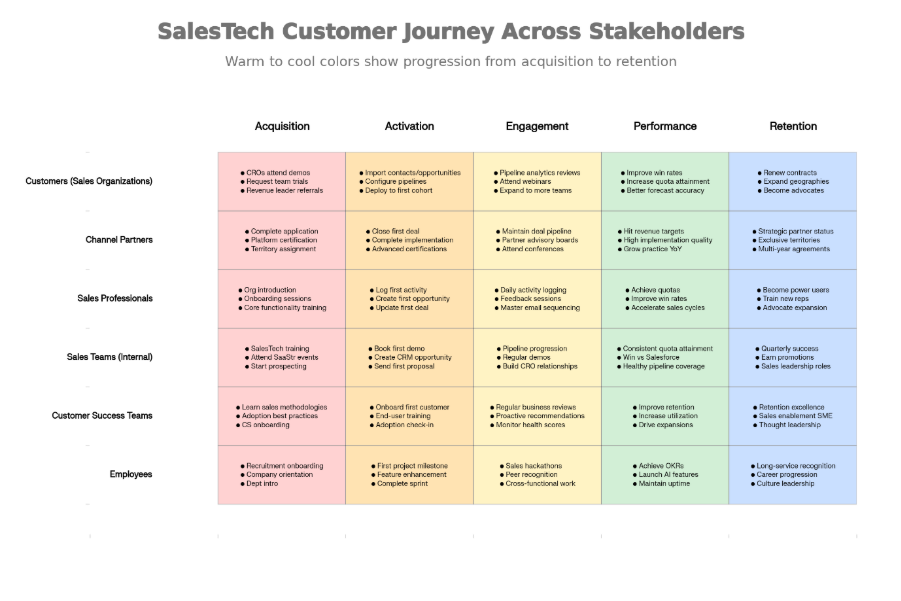
With this framework, SalesTech companies can design programs that connect every interaction, reward meaningful actions, and build stronger relationships across all touchpoints from first contact through long-term partnership.
How to motivate every persona in your SalesTech ecosystem
Once journeys are clear, the goal is execution: reward actions that improve adoption, pipeline impact, and retention. The most effective programs make progress visible, reduce lag between effort and recognition, and tie incentives directly to measurable business outcomes.
Customers (sales leaders & organizations)
Use tier-based loyalty programs (Bronze–Platinum) tied to user adoption, feature usage, and tenure to reward growing platform value.
Recognize sales performance outcomes such as improved win rates, quota attainment, and pipeline velocity with milestone-based rewards.
Accelerate time-to-value through onboarding and adoption milestones, rewarding setup completion, integrations, and full-team rollout.
Drive account growth with team expansion and integration incentives that encourage broader adoption across regions and departments.
Reward advocacy actions like referrals, reviews, and case studies to turn customers into growth partners.
Channel partners & resellers
Provide real-time commission dashboards for pipeline visibility, customer health, and payouts.
Replace quarterly cycles with automated instant payouts upon deal or activation milestones.
Run tiered partner programs with escalating commissions, support, and MDF access.
Encourage early pipeline creation via deal registration bonuses.
Reward implementation quality, retention, and portfolio growth to align partners with long-term success.
Incentivize training and certification completion to keep partners sales-ready.
Sales teams (internal)
Keep momentum high with real-time gamified leaderboards across reps, teams, and regions.
Use milestone-based SPIFFs to reward key wins between commission cycles.
Enable instant commission crediting through automated CRM-based calculations.
Drive strategic focus with segment-based accelerators and competitive win bonuses.
Shorten sales cycles using deal velocity rewards and POC-to-paid conversion incentives.
Customer success & support teams
Reward user adoption milestones and health score improvements to reinforce proactive engagement.
Recognize retention excellence and expansion identification beyond basic churn prevention.
Incentivize high-impact training delivery and customer advocacy creation.
Enable peer recognition for problem-solving and escalation prevention.
Encourage skill depth with technical certification rewards.
Employees (internal teams)
Enable continuous peer recognition across functions to build collaboration.
Automate milestone and life-event celebrations to strengthen belonging.
Tie rewards to OKRs, product launches, uptime, and innovation outcomes.
Recognize algorithm improvements and technical breakthroughs driving differentiation.
Reward cross-functional collaboration, customer immersion, hackathons, and learning.
End users (sales professionals)
Accelerate adoption with platform mastery and training rewards.
Improve CRM hygiene through data quality recognition.
Drive engagement with feature badges, streak rewards, and productivity milestones.
Encourage mobile usage via mobile-first activity incentives.
Reward feedback, beta participation, and early feature adoption to create power users.
Program architecture: How Xoxoday enables unified engagement for SalesTech
SalesTech companies manage diverse personas across customer organizations, partners, internal teams, and end users. Xoxoday brings all of this together into one connected ecosystem—customer loyalty platform for sales organizations and partners, sales incentive platform for internal revenue teams, and employee engagement platform for CS teams, end users, and internal employees.
1. Integration with SalesTech stack
Xoxoday connects directly with CRM platforms, sales engagement tools, conversation intelligence platforms, data enrichment services, and analytics systems. User activity data, adoption metrics, pipeline data, and performance indicators flow automatically through robust API integrations without manual data entry.
2. Rule-based accrual system
Configure reward rules for actions like "First Opportunity Created," "Pipeline Milestone Reached," "Feature Adoption Completed," "Quota Achieved," or "Training Certification Earned." Xoxoday's loyalty management software supports conditional logic, performance-based multipliers, and persona-specific variations.
3. Multi-persona incentive rules
Xoxoday's customer loyalty program supports different structures for customer sales organizations, resellers, internal sales teams, CS teams, end users, and internal employees. Each group receives rewards based on relevant behaviors—adoption for customers, deal volume for partners, quota for sales, retention for CS.
4. Data-driven segmentation
Segment customers by company size, industry vertical, user count, and adoption levels. Segment partners by deal volume, implementation quality, and customer satisfaction. Segment internal sales reps by territory, customer segment, and performance. Advanced segmentation enables hyper-personalized campaigns.
5. Governance and audit controls
Xoxoday's omnichannel loyalty program software provides approval workflows, comprehensive audit logs, spending limits by program or department, and role-based access controls maintaining compliance with financial policies.
6. Multichannel communication across touchpoints
Share reward notifications, adoption milestones, achievement alerts, and training reminders across email, Slack, in-app notifications, and mobile push. Sales organizations receive email summaries, partners get dashboard updates, internal sales teams see Slack alerts.
7. Real-time reporting dashboards
Provide stakeholders with visibility through analytics dashboards. Sales organizations view adoption metrics and tier progress, partners track commission status, internal sales teams see leaderboards, CS teams monitor health scores, and leadership reviews program ROI.
8. Global reward marketplace with 30+ categories
Xoxoday's rewards marketplace offers diverse options including gift cards (8,000+ brands), merchandise (100,000+ products), experiences (100,000+ options), professional development, travel, and prepaid cards across 100+ countries. Customize catalogs by persona—sales professionals prefer professional development, employees want lifestyle rewards.
Key API categories available:
- Gift Card API: 10,000+ reward options across 100+ countries with instant delivery
- Merchandise API: Physical products, tech gadgets, branded items with global fulfillment
- Experiences API: Professional development courses, certifications, conference tickets
- Perks API: Zero-cost rewards including software discounts and lifestyle benefits
Checklist for building effective engagement programs in SalesTech
Strong engagement programs are repeatable and measurable, not one-off contests. This checklist ensures rewards align to adoption and revenue outcomes, stay transparent for every persona, and can be optimized continuously using real performance and usage data.
✅ Define clear personas and map their journeys from acquisition to retention
✅ Align rewards with business outcomes: customer adoption, partner revenue, quota attainment
✅ Build tier-based structures that create progression for every stakeholder group
✅ Automate reward triggers based on real-time CRM usage, adoption, and performance data
✅ Ensure transparency in how rewards are earned, calculated, and distributed
✅ Personalize rewards based on role, performance level, and engagement patterns
✅ Offer diverse, localized redemption options across 100+ countries and 30+ categories
✅ Enable real-time dashboards for customers, partners, sales, CS, end users, and employees
✅ Implement multi-channel communication: email, Slack, in-app notifications, mobile push
✅ Build governance controls with approval workflows, spending limits, and audit trails
✅ Measure program performance through retention rates, adoption metrics, and satisfaction scores
✅ Celebrate milestones publicly through leaderboards, recognition feeds, and sales kickoffs
Conclusion: The future of engagement in SalesTech
The next phase of SalesTech growth will be shaped by how effectively companies motivate every persona in their ecosystem. Sales organizations expect rewards for adoption and performance improvements, partners want transparent incentives with instant payouts, internal sales teams need real-time commission visibility, CS teams deserve recognition for driving adoption and preventing churn, end users need appreciation for platform mastery, and employees require continuous acknowledgment.
Xoxoday brings all of this together—customer loyalty platform for sales organizations and partners, sales incentive platform for internal revenue teams, and employee engagement platform for CS teams, end users, and internal employees. With automated triggers, real-time dashboards, multi-channel communication, and a global rewards marketplace, Xoxoday makes engagement simple, scalable, and measurable.
Create a connected engagement ecosystem with Xoxoday. Book a demo to see how leading SalesTech companies drive loyalty, performance, and satisfaction across all personas.


