

On this page
The retail technology landscape has evolved into a space where differentiation is increasingly difficult. POS systems offer similar features, inventory management tools follow comparable pricing models, and e-commerce platforms provide nearly identical integrations. What now sets RetailTech companies apart is the strength of their relationships with retail merchants, implementation partners, channel resellers, sales teams, and internal employees.
Digital-first retail adoption has accelerated globally, yet many merchants struggle with platform activation, feature utilization, and long-term engagement. At the same time, loyalty has weakened. Studies show that retail merchants are willing to switch technology providers if they find better support, clearer ROI, or more responsive service.
Implementation partners and channel ecosystems have become central to growth—whether it's merchant onboarding, platform customization, integration management, or local market expansion. But without steady motivation, transparent commissions, and timely recognition, partner performance drops quickly.
Inside RetailTech companies, sales team productivity and customer success excellence directly shape merchant retention and revenue growth. Under-recognized teams lead to slower implementations, fragmented communication, and weaker merchant experiences.
All of this brings one truth to the surface: RetailTech companies can no longer grow without strong, multi-stakeholder engagement across their entire value chain.
Rewards, recognition, incentives, and real-time feedback now influence every stage of the merchant relationship, from acquisition to retention.
Major RetailTech companies across key regions
RetailTech companies across the world follow different business models, but the fundamentals of merchant engagement, partner motivation, and team excellence remain consistent. The companies below represent some of the most influential players in their respective regions, each with large merchant bases, extensive product portfolios, and growing ecosystem partnerships.
These companies set the tone for how loyalty, rewards, and performance programs are adopted at scale.
- North America: Shopify, Toast, Square, Clover, Lightspeed, NCR, Revel Systems
- Europe: iZettle, SumUp, Vend, Deliverect, Loyverse, eHopper
- India: Razorpay POS, Pine Labs, PhonePe Business, Mswipe, Paytm for Business
- Southeast Asia: StoreHub, Moka, Qashier, ebox, Biztory, FlowAccount
- Middle East: Foodics, Loyverse ME, Raqamyah, Telr, PayTabs
- Latin America: Mercado Pago, Ame Digital, PagSeguro, Linx, VTEX
How RetailTech companies operate and engage merchants today
RetailTech companies today operate through a mix of direct sales, partner-led implementations, and self-service digital onboarding—each shaped by how merchants prefer to adopt technology, how partners drive local growth, and how internal teams support the entire ecosystem. The shift isn't just operational. It has changed how merchants adopt platforms, what they expect from technology providers, and how loyalty is built.
Below is a clear breakdown of how these models function globally.
North America
- Self-service digital adoption leads the way: Small and medium-sized merchants prefer signing up online, activating accounts independently, and exploring features through guided tutorials.
- Partner-led implementations for complex setups: Multi-location retailers, restaurant chains, and enterprise merchants rely on implementation partners for customization, integration, and training.
- Ecosystem-driven growth: RetailTech platforms integrate deeply with payment processors, accounting software, e-commerce platforms, and marketing automation tools to create seamless merchant experiences.
- Subscription-based models with add-ons: Merchants start with base plans and upgrade through feature adoption, creating natural upsell opportunities tied to usage.
Europe
- Strong emphasis on compliance and data privacy: GDPR compliance, PCI-DSS standards, and localized tax regulations shape product requirements and merchant onboarding flows.
- Multi-currency and multi-language support: Merchants operating across borders need platforms that support regional payment methods, currencies, and languages seamlessly.
- Partner networks drive localized growth: VARs, system integrators, and regional distributors help RetailTech companies penetrate markets with diverse regulatory and operational needs.
- Focus on sustainability and ethical retail: Merchants increasingly expect platforms to support sustainable practices, transparent supply chains, and ethical business operations.
India
- Rapid digital payment adoption fuels growth: UPI integration, QR-based payments, and instant settlement options make RetailTech platforms essential for merchants of all sizes.
- Hybrid onboarding models: Urban merchants prefer digital onboarding, while semi-urban and rural retailers need field sales support and in-person training.
- Partner ecosystems drive tier-2 and tier-3 expansion: Local distributors, implementation partners, and merchant aggregators help RetailTech companies scale beyond metro cities.
- Integration with financial services: Merchants seek platforms that bundle POS systems with lending, insurance, and working capital solutions.
Southeast Asia
- Mobile-first merchant adoption: Small merchants prefer mobile POS apps over traditional hardware, making app-based solutions central to growth.
- Integration with super apps: Platforms that connect with Grab, Gojek, Shopee, and regional e-commerce ecosystems gain faster merchant adoption.
- Agent-led merchant acquisition: Field sales teams and local agents drive onboarding in markets with high fragmentation and diverse merchant needs.
- Cash-to-digital transition support: Many merchants are moving from cash-based operations to digital payments, requiring platforms that simplify this transition.
Middle East
- Enterprise-focused implementations: Large retail chains, hospitality groups, and QSR franchises drive demand for customized RetailTech solutions with dedicated account management.
- Multi-lingual support is essential: Arabic, English, and additional languages are required across merchant interfaces, dashboards, and customer support.
- Partner-led market entry: RetailTech companies rely on local partners to navigate regulatory requirements, cultural preferences, and merchant trust-building.
- Strong demand for loyalty and engagement features: Merchants expect built-in loyalty programs, customer engagement tools, and marketing automation as core platform features.
Behavioral shifts transforming RetailTech
Merchant expectations, partner roles, and internal team behavior have shifted quickly, and RetailTech companies now need engagement models that respond to these new patterns in real time.
1. Personalized rewards-led merchant engagement
Merchants expect relevant incentives for every milestone—from completing onboarding to activating new features, processing their first transaction, or reaching monthly volume targets.
2. AI-driven nudges for feature adoption and usage
Smart reminders influence when merchants explore new modules, complete integrations, upgrade subscriptions, or retry abandoned setup tasks.
3. Rise of ecosystem partnerships (payment gateways, e-commerce, accounting)
RetailTech platforms are using partner-driven value: bundled payment solutions, integrated accounting, seamless e-commerce sync, and marketing automation that keep merchants active.
4. Gamification for sales, partners, and customer success teams
Leaderboards, streaks, badges, and milestone rewards keep teams motivated throughout the month—not just at quarter-end.
5. Automation in partner commissions and incentives
RetailTech companies are moving away from spreadsheets to automated systems that calculate, credit, and communicate payouts instantly.
6. Multi-channel communication across WhatsApp, email, and in-app notifications
WhatsApp, SMS, email, app push notifications, and partner portals ensure engagement across merchant preferences and accessibility levels.
7. Unified visibility across merchant journeys
RetailTech companies now track how merchants move from sign-up → onboarding → activation → usage → renewal, helping them identify gaps and reward the right actions in real time.
The engagement challenge in RetailTech across personas
RetailTech companies work with multiple stakeholder groups, each playing a different role in the merchant's journey. But every group faces its own engagement challenges. These gaps directly impact merchant acquisition, activation, feature adoption, and long-term retention.
Retail merchants and brand customers
Merchants expect value at every touchpoint, but most journeys fall short of keeping them active and loyal.
- High platform churn: Loyalty drops quickly when merchants don't see clear ROI or experience slow support response times.
- Low feature activation: Merchants hesitate to explore advanced features without guided nudges or adoption incentives.
- Onboarding drop-offs: Users lose interest after sign-up when there are no meaningful prompts or rewards to complete setup.
- Weak repeat usage: Transaction volumes, feature utilization, and subscription upgrades stay low without habit-building triggers.
- Low share-of-wallet: Merchants distribute their operations across multiple platforms seeking better features, pricing, or support.
Implementation partners and system integrators
Partners drive merchant onboarding and customization, yet most feel disconnected from the RetailTech company's incentive structure.
- Manual commission tracking: Spreadsheet-driven payouts lead to delays, errors, and unnecessary back-and-forth.
- Poor milestone visibility: Partners struggle to track implementation progress, pending approvals, or upcoming earnings without real-time dashboards.
- Mid-project motivation dips: Performance slows down when there are no checkpoints or milestone-based rewards during long implementation cycles.
- Low trust in validations: Slow approval workflows make partners skeptical about earning commissions accurately and on time.
Channel partners and resellers
Resellers contribute significantly to merchant acquisition, referrals, and regional expansion, but engagement remains sporadic.
- Minimal recognition: Their role often goes unnoticed outside specific campaigns or product launches.
- Inconsistent incentives: Rewards differ across regions or product lines, making collaboration unclear and unpredictable.
- Limited performance insights: Partners rarely see how their referrals convert, which merchants are active, or what revenue they've influenced.
- Campaign-only engagement: Momentum disappears between campaigns due to a lack of continuous touchpoints and ongoing recognition.
Sales teams (AEs, SDRs, enterprise sales)
Sales teams drive merchant acquisition and account expansion, yet daily motivation often varies based on cycles and visibility.
- End-of-quarter pressure: Productivity surges only in the final weeks because targets aren't gamified daily or weekly.
- Low daily momentum: Teams lose steam without nudges, progress updates, or recognition for incremental wins.
- Limited recognition: Small victories, pipeline movement, and early deal contributions rarely get acknowledged in real time.
- Fragmented visibility: Disconnected systems prevent teams from seeing regional comparisons, peer performance, or leaderboard rankings clearly.
Customer success and support teams
CS teams carry the weight of merchant satisfaction and retention, often without parallel recognition systems.
- CSAT-driven stress: Teams are accountable for merchant experience but don't receive rewards linked to performance outcomes.
- Heavy case load: Peaks in support tickets, implementation issues, and merchant escalations create sustained pressure without added appreciation.
- Little appreciation: Preventing churn, resolving complex technical issues, and maintaining high satisfaction scores rarely get acknowledged.
- Low morale during launches: New product rollouts and feature releases increase workload significantly when recognition doesn't keep pace.
Employees (product, engineering, marketing, operations)
Internal teams influence merchant experience more than they realize and deserve continuous appreciation.
- Under-appreciation: High operational workloads, feature releases, and infrastructure improvements receive very little day-to-day recognition.
- Cultural silos: Teams operate independently across product, engineering, marketing, and operations, leading to low collaboration and morale.
- No continuous recognition: Recognition is tied to annual reviews or major launches instead of ongoing contributions and achievements.
- Invisible contributions: Efforts that improve platform performance, reduce merchant friction, or enhance support workflows aren't highlighted enough.
The 5-journey framework for RetailTech companies
Every stakeholder in your RetailTech ecosystem moves through five distinct stages. Understanding these journeys helps you design targeted engagement strategies that drive meaningful outcomes at each phase of the relationship.
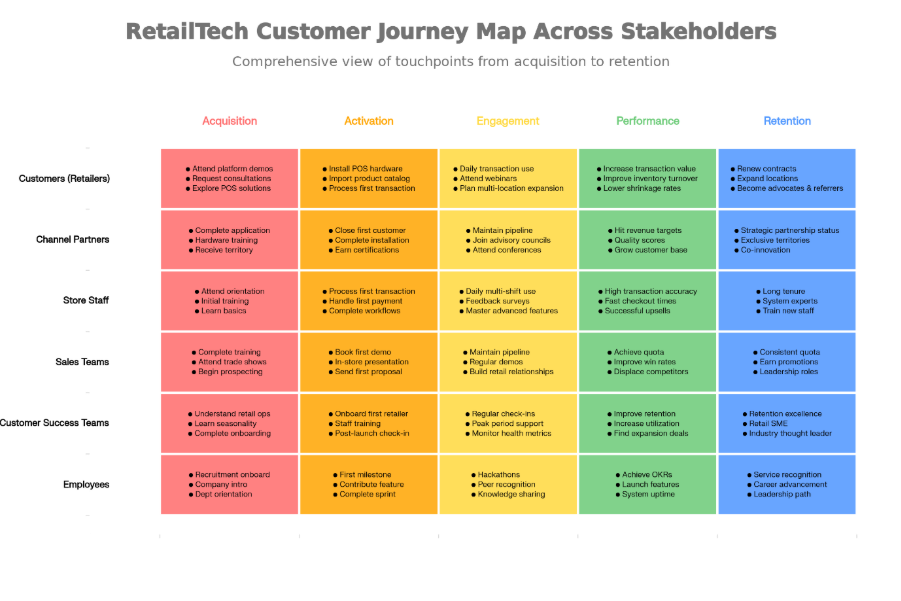
With this framework, RetailTech companies can design programs that connect every interaction, reward meaningful actions, and build stronger relationships across all touchpoints from first contact through long-term partnership.
How RetailTech companies can motivate every persona across their value chain
A RetailTech company's ecosystem runs on the energy of different personas. Each group expects recognition that matches its role, contribution, and daily realities. Below are refined, more informative ways RetailTech companies motivate every persona using rewards, challenges, communication flows, and structured engagement programs.
Retail merchants and brand customers
Merchants respond best when a RetailTech platform connects value with their daily business operations.
- Tier-based loyalty programs with real privileges: RetailTech platforms can run tier structures where transaction volumes, feature adoption, or subscription tenure move merchants to higher benefit levels such as priority support, fee discounts, premium integrations, or exclusive feature access.
- Rewards linked to business milestones: Everyday actions like processing their 100th transaction, activating a new payment method, or completing their first month with zero downtime build consistent engagement.
- Marketplace-led motivation: Offering merchants access to a rewards marketplace with categories like business tools, software subscriptions, e-commerce credits, marketing budgets, and partner services makes reward redemption aspirational and relevant.
- Referral-driven acquisition: Programs such as "Refer a merchant and earn premium support credits when they activate" help merchants participate in growth while receiving tangible benefits.
- Seasonal and event-based engagement: RetailTech platforms can run programs like "Holiday Sales Boost," "Black Friday Readiness Rewards," or "New Year Growth Challenges" to keep momentum high throughout the year.
- Feedback that leads to visible change: When merchants share feature requests through surveys and see real improvements shortly after, it strengthens trust and platform loyalty.
CTA: Build stronger merchant loyalty with personalized rewards and journey-based engagement. Book a demo to explore real program examples.
Implementation partners and system integrators
Partners stay active when they can see earnings clearly, feel recognized early, and experience fair payout cycles.
- Clear earnings dashboards: A simple interface showing active projects, pending merchant activations, expected commissions, and upcoming payouts helps partners plan their pipeline with confidence.
- Early achievement bonuses: Partners receiving small rewards for the first five successful implementations or the first ten merchant activations stay motivated through slower project cycles.
- Short-term implementation challenges: RetailTech companies can run contests such as "Weekend Onboarding Sprint," "Feature Activation Drive," or "Integration Challenge Month" to generate spikes in partner performance.
- Fast and error-free payouts: When partners experience quick crediting without long manual validations, their trust in the RetailTech company grows significantly.
- Recognition in partner communities: Highlighting top partners in newsletters, partner portals, or quarterly events creates healthy competition and professional pride.
- Certification-linked rewards: Partners completing product training, integration certifications, or compliance modules earn badges or incentives that support skill development and platform expertise.
CTA: Motivate your implementation partner network with transparent commissions and rewarding performance journeys. Book a demo to see how leading RetailTech companies do it.
Channel partners and resellers
Resellers influence merchant decision-making through recommendations, local market knowledge, and on-ground support.
- Structured partner clubs: RetailTech companies can introduce partner clubs with tier names like "Silver Partner," "Gold Partner," or "Platinum Partner," each offering better rewards, marketing support, and priority access to new features.
- Outcome-driven bonuses: Rewarding partners for high-quality merchant referrals, premium plan conversions, or consistent monthly deal registrations helps align objectives clearly.
- Real-time deal visibility: Partners benefit from dashboards that show approved merchants, commissions earned, and upcoming milestones, which helps them prioritize their sales efforts better.
- Co-marketing campaigns and digital kits: RetailTech companies can provide ready-made campaign materials including banners, email templates, and landing pages to help partners attract more merchants effectively.
- WhatsApp-based engagement: Automated updates, incentive reminders, and target progress can all be shared through WhatsApp for ease and immediacy.
- Recognition forums: Quarterly partner awards, spotlight sessions, or virtual recognition events strengthen long-term commitment and community building.
CTA: Engage channel partners with structured incentives and real-time performance visibility. Book a demo to discover proven partner engagement frameworks.
Sales teams
Sales teams thrive when they have visibility, recognition, and a sense of momentum throughout the quarter.
- Performance contests across regions and teams: Challenges such as "Top Merchant Onboarders," "Enterprise Deal Champions," or "Fastest Demo-to-Close Stars" keep sales cycles competitive and energetic.
- Live leaderboards: Real-time visibility into rankings helps sales teams stay invested in daily progress rather than waiting for end-of-quarter reviews.
- Instant payout triggers: When commissions are credited immediately after merchant activation or contract signature, sales teams stay confident and driven.
- Daily progress nudges: Smart notifications remind sales staff of warm leads, pending follow-ups, or cross-sell opportunities with existing merchants.
- Micro-recognition rituals: Quick celebrations for milestones like "First Deal of the Week" or "Fastest Five Demos" make motivation frequent and consistent.
- Role-based reward structures: AEs, SDRs, enterprise sales, and inside sales teams receive incentives tailored to their specific KPIs and performance metrics.
CTA: Boost sales productivity with real-time leaderboards and instant incentive cycles. Book a demo to see how RetailTech companies keep teams energized.
Customer success and support teams
CS teams shape merchant sentiment more than any automated journey ever can.
- CSAT-linked reward programs: Improving satisfaction scores, reducing ticket escalations, or achieving stable service quality can unlock meaningful rewards tied directly to performance outcomes.
- Recognition for complex resolutions: Handling tough technical queries, preventing merchant churn, or solving critical integration issues is worth acknowledging with specific incentives.
- Performance nudges: Simple cues about open tickets, SLA timelines, or priority merchant queues help teams focus on what matters most.
- Service milestones: Completing a quarter with zero escalations or maintaining high first-contact resolution rates builds pride and visibility across the organization.
- Peer and manager appreciation: Short thank-you messages or public recognition during team huddles keep morale high and create a culture of appreciation.
- Performance dashboards: Real-time visibility helps support teams understand where they stand and how they can improve their impact on merchant satisfaction.
CTA: Elevate your service quality with CSAT-driven rewards and transparent performance insights. Book a demo to explore proven customer support programs.
Employees (product, engineering, marketing, operations)
Support functions influence merchant experience more than they realize and deserve continuous appreciation.
- Everyday recognition moments: RetailTech companies can highlight product teams launching features, engineering resolving critical bugs, marketing driving merchant campaigns, or operations improving workflows. Small, frequent recognition builds a stronger internal culture.
- Milestone and life-event celebrations: Work anniversaries, personal milestones, and skill certifications can be treated as moments worth rewarding and celebrating.
- Cross-team appreciation features: Employees can thank colleagues who help them complete projects, prevent merchant issues, or improve platform stability.
- Pulse surveys with visible changes: Collecting feedback is only half the work. Showing employees what changed because of their input is what builds trust and engagement.
- Knowledge and skill-based rewards: Completing mandatory training, compliance modules, or new certifications can unlock badges or small rewards that encourage continuous learning.
- Visibility through internal communities: Company intranets, social feeds, and peer shout-outs help teams feel connected across locations and departments.
Create a workplace where employees feel valued and connected. Book a demo to explore modern recognition and rewards programs.
Program architecture for RetailTech: How Xoxoday enables a unified rewards system
RetailTech companies manage multiple personas and large volumes of merchant activity every day. Xoxoday helps bring all of this together into one connected rewards and engagement ecosystem. The platform integrates with core RetailTech systems, simplifies complex reward rules, and gives every persona a clear view of how they earn, redeem, and grow within the company's programs. Below is a refined breakdown of how this unified architecture comes to life.
1. Integration with core RetailTech platforms, CRM, and support systems
Xoxoday connects directly with the systems RetailTech companies rely on the most. Merchant transactions, partner deal registrations, sales pipeline updates, and employee performance milestones all flow into the platform automatically. This ensures rewards are always based on verified activity without manual effort.
2. Rule-based accrual system
RetailTech companies can configure simple or advanced reward rules inside Xoxoday. Actions like "First Transaction Processed," "Feature Activated," "Implementation Completed," or "Training Finished" can be converted into instant rewards. Clear rules reduce confusion, eliminate delays, and help maintain fairness across all personas.
3. Multi-persona incentive rules
Xoxoday supports different incentive structures for merchants, implementation partners, resellers, sales teams, customer success teams, and employees. Each group receives rewards based on the behavior that matters to their role. All programs run from the same platform but follow independent logic that fits each persona's journey.
4. Data-driven segmentation
RetailTech companies can segment merchants by usage patterns, partners by performance tiers, employees by department or engagement level, and sales teams by regional performance. These segments help personalize campaigns, rewards, and communication without creating additional workload for internal teams.
5. Governance and audit controls
Xoxoday provides the control structure RetailTech companies need to maintain compliance. Approval workflows, audit logs, spending controls, and permission-based access ensure every reward follows the correct process. This reduces operational risks and strengthens program credibility.
6. Multi-channel communication across WhatsApp, SMS, app, and email
Reward notifications, progress updates, and reminders can be shared across multiple channels. Merchants may receive app or WhatsApp updates, partners may get email alerts, and employees may see recognition appear on internal communication tools. This keeps engagement active across different points of interaction.
7. Real-time reporting dashboards
Dashboards help stakeholders see where they stand. Merchants view loyalty points and tier status, partners see commissions and milestones, sales teams track leaderboards, and managers monitor program performance. This level of transparency encourages continuous improvement.
8. Reward marketplace configuration
Xoxoday offers a wide marketplace of rewards that RetailTech companies can customize. Merchants may see business tools and software subscriptions, partners may prefer instant redemption choices, and employees may enjoy wellness or experience-based rewards. The marketplace becomes the emotional driver behind every engagement program.
Checklist for building effective RetailTech engagement programs
RetailTech companies run multiple engagement programs across merchants, partners, employees, and internal teams. The most successful programs follow a few common principles that keep them effective, scalable, and aligned with business goals. Below is a practical checklist RetailTech companies should follow when designing or refining their engagement and reward systems.
- Define clear strategies tailored to each persona—merchants, partners, sales teams, CS teams, and employees
- Build tier-based progression structures to create advancement motivation
- Set up real-time nudges and transparent incentive logic that stakeholders can trust
- Enable instant reward crediting to eliminate delays and maintain momentum
- Use data-driven segmentation to personalize campaigns and communication
- Implement audit-ready processes with approval flows and spending controls
- Test, optimize, and scale programs iteratively based on performance data
- Provide real-time dashboards so every persona can track progress transparently
Conclusion: The future of engagement in RetailTech
RetailTech companies that prioritize multi-stakeholder engagement will lead the next phase of industry growth. Xoxoday unifies merchant loyalty, partner incentives, sales performance, and employee recognition into one platform—making engagement simple, scalable, and measurable.
With real-time rewards, automated journeys, and meaningful redemption options, RetailTech companies can strengthen relationships across every touchpoint while reducing operational complexity.
Book a demo to see how leading RetailTech companies drive loyalty, performance, and satisfaction across all personas.


