
How Restaurant Tech Companies Can Drive Adoption, Retention, and Performance Through Unified Engagement
Restaurant tech growth depends on more than features. Discover how unified engagement strategies help platforms drive adoption, motivate partners and teams, reduce churn, and scale across regions.

On this page
The global restaurant industry continues to rebound and evolve rapidly in 2025, with total sales projected to exceed $1.5 trillion in the United States alone and digital ordering growing faster than traditional dine-in traffic.
Modern restaurant technology solutions are no longer optional; 92 % of top-performing restaurants now use mobile order-and-pay systems, and digital ordering has expanded 300 % faster than dine-in since 2014, reshaping how operators manage orders, staff, and overall efficiency.
Despite this growth, restaurants still operate on tight margins and face intense operational pressure. Recruiting and retaining staff remains a top challenge for 62 % of operators, while hourly employee turnover rates have reached 75 %, adding to training burdens and service complexity.
In this environment, restaurant tech companies can no longer win on features alone. Independent operators struggle to prove ROI, partners need better visibility and incentives, sales teams confront longer cycles, and customer success teams face high support demand during peak hours.
Across regions, from India’s cloud kitchen boom and Southeast Asia’s delivery aggregator dependence to Europe’s VAT complexity and the U.S. focus on self-service and analytics, effective stakeholder engagement has become the key differentiator.
This blog explores how restaurant tech companies can build unified engagement strategies that motivate operators, partners, sales teams, support teams, internal employees, and frontline restaurant staff to drive adoption, performance, and long-term retention at scale.
Major restaurant tech companies across key regions
These companies represent the most influential players across global markets, each managing complex ecosystems of independent restaurants, chains, franchises, resellers, and internal teams. From India's cloud kitchen revolution to the self-service kiosk preference of US quick-service restaurants, each region presents unique engagement challenges that require tailored approaches.
With this landscape in mind, let's examine how restaurant tech companies operate differently across geographies and what that means for stakeholder engagement.
How restaurant tech companies operate across geographies
Restaurant operations are deeply shaped by local behavior, delivery aggregator dominance, payment preferences, compliance norms, and language needs vary by region. These factors directly influence onboarding complexity, support expectations, and what “value” looks like for operators. The result: restaurant tech companies must adapt GTM and engagement strategies market by market.
India
SMB and cloud kitchen focus with delivery integration dominance: Majority of customers are independent restaurants, cloud kitchens, and QSR chains seeking affordable all-in-one solutions. Integration with Zomato and Swiggy is non-negotiable. GST and FSSAI compliance features are mandatory. WhatsApp-based ordering and customer notifications are standard expectations. Price sensitivity is high with thin operating margins requiring clear ROI demonstration.
Southeast Asia
Mobile-first with delivery aggregator dependency: Multi-language menu and receipt support required across diverse markets. High smartphone penetration drives mobile ordering and payment adoption. Street food vendors and hawker centers increasingly digitizing operations. Integration with GrabFood, Foodpanda, and local delivery platforms mandatory. Cash remains dominant despite growing digital payment acceptance. Halal compliance features needed in Muslim-majority markets.
Middle East
Premium dining and hospitality focus: Strong emphasis on luxury hotel F&B and fine dining segments. Arabic language support for menus, receipts, and customer-facing displays essential. High tourist traffic requires multi-currency and multi-language capabilities. Integration with Talabat, Deliveroo, and Careem mandatory. Ramadan-specific features including Iftar timing and special menu handling. Premium white-glove support expectations.
United States
Self-service with advanced analytics expectations: Customers expect intuitive UI with minimal training required. Self-service kiosks and mobile ordering standard for QSR segment. Advanced labor management, inventory optimization, and predictive analytics expected. Deep integration with payment processors like Square, Stripe, and Clover. Third-party delivery platform proliferation (DoorDash, UberEats, Grubhub) requires unified management. PCI-DSS compliance and health department reporting automation mandatory.
Europe
GDPR compliance with VAT complexity: Customer data and loyalty program management must comply with strict privacy regulations. VAT handling varies significantly across countries requiring sophisticated tax management. Multi-language support across single restaurant groups common. Tipping culture and payment splitting preferences differ dramatically by country. Integration with Deliveroo, Just Eat, and regional platforms. Strong emphasis on data security and privacy throughout the tech stack.
These operational differences directly shape the pain points each stakeholder group experiences in their daily interactions with restaurant technology.
Behavioral shifts transforming restaurant tech
Before diving into persona-specific challenges, it's important to understand the broader behavioral shifts reshaping how restaurant tech companies must approach engagement:
1. Cloud-based systems replacing legacy on-premise POS: Restaurants expect web-based access, automatic updates, multi-location management, and no server maintenance costs.
2. Mobile and tablet ordering becoming standard: Tableside ordering via handheld devices improves service speed, order accuracy, and average check size through suggestive selling.
3. Third-party delivery integration non-negotiable: Seamless integration with UberEats, DoorDash, Zomato, Swiggy, GrabFood now determines platform viability and market competitiveness.
4. Contactless and QR code ordering post-pandemic: Customers scanning QR codes to view menus and order directly from tables reduces labor costs and improves table turnover.
5. Data-driven decision making expected: Restaurant owners want real-time analytics on sales trends, labor costs, inventory levels, and customer behavior to optimize operations.
6. Loyalty programs driving repeat business: Digital loyalty programs replacing physical punch cards to increase visit frequency, average check size, and customer lifetime value.
7. Staff turnover requiring intuitive systems: High employee churn (75% annually) demands systems that are exceptionally easy to learn with minimal training investment.
8. Omnichannel ordering expectations: Customers want seamless ordering via app, web, phone, kiosk, or in-person with consistent menu, pricing, and experience.
With these shifts in mind, let's examine the specific engagement challenges each persona faces in the restaurant tech ecosystem.
The engagement challenge across restaurant tech personas
Restaurant tech success depends on more than the buyer. Operators purchase, but staff adoption determines daily outcomes; partners influence decisions; sales drives conversion; CS handles high-stakes support; internal teams ship reliability and integrations. Breaking challenges down by persona reveals where engagement drops, and where targeted incentives can prevent churn.
Customers (restaurant owners & operators)
Who they are: Restaurant owners, F&B directors, multi-location operators, QSR managers, fine dining operators, cloud kitchen owners, franchise owners
Challenges they face:
- High staff turnover (75% annually) making training on new systems expensive, time-consuming, and operationally disruptive
- System downtime directly impacts revenue, no orders processed means immediate lost sales and frustrated customers
- Difficulty proving ROI on technology investments to justify ongoing subscription costs
- Integration nightmares with existing tools including accounting software, inventory management, payroll systems, and delivery platforms
- Generic loyalty programs that don't drive meaningful repeat visits or increase average check size
- Steep learning curve for feature-rich platforms overwhelming busy restaurant operators
- Poor technical support during peak hours (Friday and Saturday dinner service) when help is most critical
Addressing customer engagement requires parallel focus on the reseller partners who influence their technology buying decisions.
Channel partners & resellers
Who they are: Restaurant technology consultants, POS resellers, implementation partners, regional distributors, restaurant design firms that bundle tech, F&B consulting firms
Challenges they face:
- Manual commission tracking through spreadsheets causing payment delays, errors, and frequent disputes
- No real-time visibility into installation schedules, customer satisfaction scores, or account health
- Inconsistent incentives varying by region, product line, or promotional period creating confusion
- Limited training on new features and product updates affecting their ability to sell effectively
- Partners inactive between promotional campaigns due to lack of ongoing touchpoints and engagement
- Difficult onboarding processes for new restaurant customers affecting time-to-value
- Lack of co-branded marketing collateral and sales enablement materials to support local selling efforts
While partners bring customers in, sales teams are responsible for converting prospects and expanding existing relationships.
Sales teams (SDRs, AEs, enterprise sales)
Who they are: Sales Development Representatives, Account Executives, Enterprise Sales Teams targeting chains and franchises, Customer Success Managers handling expansion
Challenges they face:
- Long sales cycles (30-90 days) for independent restaurants with multiple decision-makers and budget constraints
- Losing competitive deals to entrenched legacy systems like Toast, Square, Lightspeed, and NCR Aloha
- Difficulty demonstrating clear ROI during demos when restaurants are focused on day-to-day operations
- Delayed commissions (30-45 days post-closure) reducing motivation during long sales cycles
- Limited visibility into competitive landscape and win/loss patterns across territories
- Challenge converting free trial users before they lose interest or revert to existing systems
- Seasonality affecting sales patterns as restaurant openings cluster in certain periods
Once sales closes deals, customer success teams take over the critical retention, training, and expansion work.
Customer success & support teams
Who they are: Customer Success Managers, Implementation Specialists, Technical Support Engineers (24/7 support critical), Training Teams, Account Managers for multi-location customers
Challenges they face:
- High support ticket volume during peak dining hours (Friday/Saturday nights) creating stress and burnout
- Managing diverse customer sophistication levels from tech-savvy operators to traditional mom-and-pop restaurants
- System outages causing immediate customer panic as they can't process orders or payments
- Difficulty scheduling training sessions around restaurant operating hours (typically closed 3-5pm)
- Limited recognition for preventing churn or successfully rescuing at-risk accounts
- Burnout from demanding 24/7 support expectations without structured appreciation programs
- Language barriers with diverse restaurant staff across different cultural backgrounds
While CS teams face external pressures, internal employees drive the product innovation and operations that power everything.
Employees (restaurant tech company's internal teams)
Who they are: Product & Engineering Teams, Marketing & Content Teams, Operations, Finance, Legal, Compliance, Internal HR Teams, Customer Experience & Design Teams
Challenges they face:
- Product teams under constant pressure for rapid feature releases in competitive market
- Engineering teams managing legacy code, technical debt, and hardware compatibility issues
- Operations teams coordinating hardware logistics, replacements, and field service technicians
- Limited recognition for backend teams compared to customer-facing sales roles
- Remote engineering teams feeling disconnected from real restaurant operational realities
- Innovation contributions going unnoticed without structured reward programs
- High stress during major product launches, peak season support, and system migrations
Restaurant staff represent a unique persona, they're not employees of the tech company, but their daily adoption determines system success.
Restaurant staff (end users)
Who they are: Servers, bartenders, cashiers, kitchen staff, chefs, line cooks, shift managers, floor managers, delivery coordinators
Challenges they face:
- Frequent system changes causing confusion and slowing down service during busy shifts
- Insufficient training time during busy operational periods affecting confidence and accuracy
- Fear of making mistakes that affect tips, customer satisfaction, or order accuracy
- System complexity overwhelming for part-time staff who work limited hours weekly
- High turnover (75% annually) means constant retraining of new employees on the same system
- Language barriers with English-only systems in diverse restaurant environments
- No structured input mechanism into system improvements despite being daily power users
Understanding these challenges is the first step. The real solution lies in mapping each persona's journey and designing engagement strategies for every stage.
The 5-journey framework for restaurant tech companies
Every stakeholder in your restaurant tech ecosystem moves through five distinct stages: Acquisition → Activation → Engagement → Performance → Retention. Designing targeted programs for each stage ensures you're motivating the right behaviors at the right time across all personas.
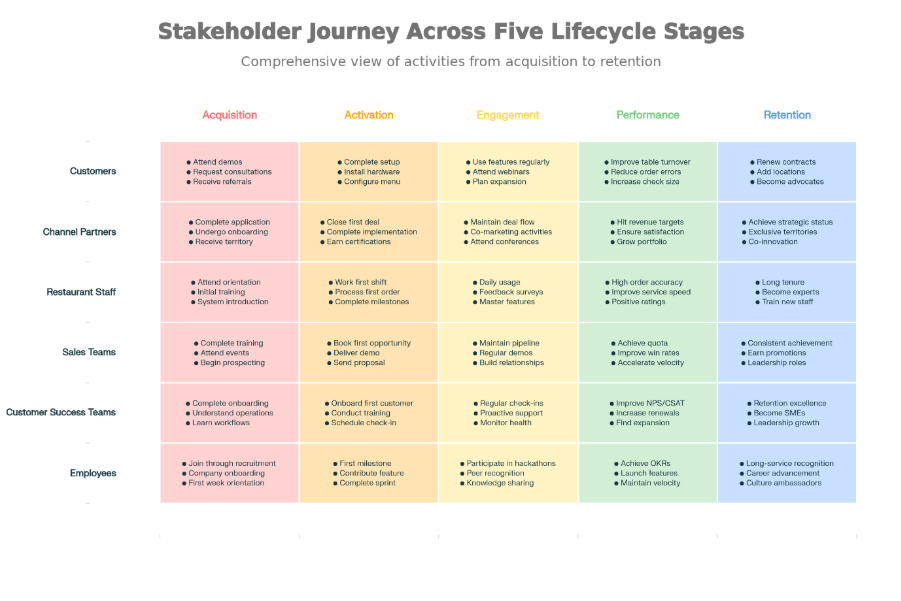
This framework provides the structure, but effectiveness comes from persona-specific motivation strategies powered by the right engagement technology.
How to motivate every persona in your restaurant tech ecosystem
Once journeys are mapped, motivation becomes execution: reward behaviors that improve adoption, performance, and retention. The most effective programs are measurable, automated, and tailored, helping restaurants see ROI, partners stay active, revenue teams stay motivated, and frontline staff use the system correctly under pressure.
Customers (restaurant owners & operators)
Tier-based loyalty programs: Create usage tiers (Bronze, Silver, Gold) based on transaction volume and feature adoption. Higher tiers unlock priority support and fee waivers through Xoxoday's customer loyalty platform with automated tier progression.
Operational metrics rewards: Recognize restaurants that improve table turnover, reduce order errors, or optimize labor costs through milestone rewards tied to business outcomes.
Advocacy incentives: Reward restaurant owners who refer other operators or participate in case studies with statement credits and hardware discounts via referral tracking with dual rewards.
Onboarding milestone rewards: Break implementation into phases and reward each completion, POS setup, menu configuration, staff training, to accelerate time-to-value.
Multi-location expansion bonuses: Incentivize adding new locations with volume discounts and implementation credits when expansion targets are met.
Channel partners & resellers
Real-time commission dashboards: Provide instant visibility into deal status and payouts through Xoxoday's partner management solution, eliminating disputes.
Automated instant payouts: Replace quarterly checks with 48-hour commission crediting via digital gift cards or direct deposits across 100+ countries.
Tiered partnership programs: Create partner levels (Authorized, Silver, Gold, Platinum) with escalating commission rates and benefits through automated tier management.
Deal registration bonuses: Reward partners immediately upon qualified lead registration with instant point credits.
Installation quality incentives: Recognize partners with high customer satisfaction scores through post-installation NPS tracking.
Sales teams (SDRs, AEs, enterprise sales)
Real-time gamified leaderboards Display live rankings across individuals and teams through Xoxoday's sales incentive platform to maintain visibility throughout the month.
Milestone-based SPIFFs Reward achievements like "First Demo This Week" or "Won Against Toast" through automated SPIFF programs maintaining momentum.
Automated commission tracking Integrate with CRM to auto-calculate commissions based on deal size and product mix with instant post-installation crediting.
Competitive win celebrations Create special rewards for displacing Toast, Square, or Lightspeed with battle card-linked incentives.
Customer success & support teams
Customer health score rewards Recognize CSMs who move at-risk restaurants to healthy status through Xoxoday's employee recognition platform.
CSAT-linked incentives Tie rewards to maintaining high satisfaction during peak hours with automatic recognition for five-star support interactions.
Implementation excellence bonuses Celebrate successful onboardings completed ahead of schedule with high initial usage rates.
Churn prevention acknowledgment Recognize team members who identify and rescue at-risk accounts through "Save of the Quarter" programs.
Employees (restaurant tech company's internal teams)
Continuous peer-to-peer recognition Enable employees to appreciate colleagues through social recognition feeds via Xoxoday's employee engagement platform.
Milestone celebrations Automatically recognize birthdays, anniversaries, and promotions through milestone tracking.
Performance-based rewards Link recognition to OKR achievement, sprint completions, and product launches through performance integration.
Innovation hackathons Run internal competitions for solving customer pain points with meaningful rewards from a global catalog.
Restaurant staff (end users)
Training completion rewards Incentivize system training completion with gift cards through learning system integration.
Error-free performance recognition Recognize staff with zero order errors through real-time performance tracking.
Feature mastery badges Award digital badges for mastering advanced features, creating friendly competition.
Tenure milestone celebrations Recognize 6-month and 1-year tenure achievements, rare in 75% annual turnover industry.
Program architecture: How Xoxoday enables unified engagement for restaurant tech
Restaurant tech companies manage diverse personas across acquisition, daily operations, support, and internal teams. Xoxoday brings all of this together into one connected ecosystem, Xoxoday's customer loyalty platform for restaurants and partners, sales incentive platform for revenue teams, and employee engagement platform for CS teams, staff, and internal employees.
1. Integration with restaurant tech stack
Xoxoday connects directly with POS systems, kitchen display systems, online ordering platforms, delivery aggregators, CRMs, and support ticketing systems. Transaction data, menu configurations, staff activities, and customer interactions flow automatically through robust API integrations and pre-built connectors without manual data entry.
2. Rule-based accrual system
Configure reward rules for actions like "First Successful Service," "100 Orders Processed," "Online Ordering Activated," or "Staff Training Completed." Xoxoday's loyalty management software supports conditional logic, time-based multipliers (happy hour bonuses), and restaurant-type variations (QSR vs. fine dining).
3. Multi-persona incentive rules
Xoxoday's customer loyalty program supports different structures for restaurants, resellers, sales teams, CS teams, internal employees, and restaurant staff. Each group receives rewards based on relevant behaviors, transaction volume for restaurants, deal quality for partners, quota attainment for sales, CSAT scores for support, training completion for staff.
4. Data-driven segmentation
Segment restaurants by cuisine type, location density, transaction volume, and feature adoption. Segment partners by territory, customer portfolio size, and implementation quality. Segment sales reps by territory performance and product mix. Advanced segmentation enables hyper-personalized campaigns and targeted communication.
5. Governance and audit controls
Xoxoday's omnichannel loyalty program software provides approval workflows, comprehensive audit logs, spending limits by program, and role-based access controls. This maintains compliance with financial policies and reduces operational risks as programs scale globally.
6. Multichannel communication across touchpoints
Share reward notifications, training reminders, milestone alerts, and performance updates across SMS, WhatsApp, email, and in-app notifications. Restaurants receive SMS alerts, partners get email summaries, sales teams see Slack updates, and staff receive in-app recognition.
7. Real-time reporting dashboards
Provide stakeholders with visibility through analytics dashboards. Restaurants view usage patterns and loyalty tier progress, partners track commission status, sales teams monitor leaderboards, CS teams see health scores, and leadership reviews program ROI and engagement metrics across all personas.
8. Global reward marketplace with 30+ categories
Xoxoday's rewards marketplace offers diverse options including gift cards (8,000+ brands), merchandise (100,000+ products), experiences (100,000+ options), travel, charity (10,000+ causes), mobile top-ups, and prepaid cards across 100+ countries. Customize catalogs by persona, restaurants prefer operational supplies, staff want meal vouchers, partners need business tools.
Key API categories available:
- Gift Card API: 10,000+ reward options across 100+ countries with instant delivery and fraud prevention
- Merchandise API: Physical products, branded items, restaurant supplies with global fulfillment
- Mobile Top-Up API: Instant recharges valuable in emerging markets with high staff mobile usage
- Perks API: Zero-cost rewards including always-on deals, discounts, and lifestyle benefits for cost-conscious restaurants.
Checklist for building effective engagement programs in restaurant tech
Sustainable engagement programs aren’t built on rewards alone, they’re built on clarity, automation, personalization, and measurement. This checklist helps ensure every initiative ties back to outcomes like retention, location expansion, operational efficiency, satisfaction scores, and adoption depth.
✅ Define clear personas and map their journeys from acquisition to retention
✅ Align rewards with business outcomes: customer retention, location expansion, operational efficiency
✅ Build tier-based structures that create progression for every stakeholder group
✅ Automate reward triggers based on real-time POS, CRM, and operational data
✅ Ensure transparency in how rewards are earned, calculated, and distributed
✅ Personalize rewards based on restaurant type, size, geography, and performance
✅ Offer diverse, localized redemption options across 100+ countries and 30+ categories
✅ Enable real-time dashboards for restaurants, partners, sales, CS, staff, and employees
✅ Implement multi-channel communication: SMS, WhatsApp, email, in-app notifications
✅ Build governance controls with approval workflows, spending limits, and audit trails
✅ Measure program performance through retention rates, location expansion, and satisfaction scores
✅ Celebrate milestones publicly through leaderboards, recognition feeds, and partner events
Conclusion: The future of engagement in restaurant tech
The next phase of restaurant tech growth will be shaped by how effectively companies motivate every persona in their ecosystem. Restaurant operators expect rewards for adoption, partners want transparent incentives, sales teams need real-time visibility, CS teams deserve appreciation, employees require acknowledgment, and restaurant staff need recognition.
Xoxoday brings all of this together, customer loyalty platform for restaurants and partners, sales incentive platform for revenue teams, and employee engagement platform for CS teams, staff, and internal employees.
With automated triggers, real-time dashboards, multi-channel communication, and a global rewards marketplace spanning 30+ categories across 100+ countries, Xoxoday makes engagement simple, scalable, and measurable.
Book a demo to see how leading restaurant tech companies drive loyalty, performance, and satisfaction across all personas.


