On this page
Artificial Intelligence, loyalty analytics, and hyper-personalization—along with other big and small disruptions—are shattering ceilings, erasing limitations, and rewriting the playbook for loyalty. Have you been keeping up?
In the US, loyalty is moving fast. What used to be a simple system of points and rewards has now evolved into a complex, tech-powered engine designed to meet rising expectations. Customers want more than perks—they want seamless mobile experiences, tailored interactions, instant benefits, and a sense of meaning behind every brand touchpoint.
At the same time, businesses are leveraging AI, gamification, and loyalty analytics to stay competitive. They’re rethinking what loyalty should look like and rebuilding their programs to deliver deeper connections and better results.
If you're reworking your loyalty strategy, this is the place to start.
In this comprehensive guide cum heads-up, we cover:
- The big disruptions and opportunities shaping the US loyalty landscape
- How tech waves and digital trends – AI in particular – are catalyzing change
- Points to keep in mind when giving your company’s loyalty program a tech revamp
What customers expect from loyalty programs in 2026
Loyalty is no longer driven by just brand familiarity or transactional value. Customers now measure loyalty programs by how well they fit into their everyday lives. They want speed, flexibility, and a sense of belonging, all delivered through seamless digital experiences.
Here are the five expectations shaping the new standard for loyalty in 2026:
- Convenience, practicality, speed
- Tech-enabled, mobile-optimized experiences
- Tailored moments via deep personalization
- Purpose, meaning, community
- Flexible earn and burn options
These are not just nice-to-haves, they’re the new baseline. And brands that meet them are the ones winning long-term trust and engagement.
The action intensifies, the excitement thickens. State of us loyalty in 2026
Rising customer expectations are inspiring grander innovations from brands.
- US consumers say loyalty programs make them feel more connected to the brand
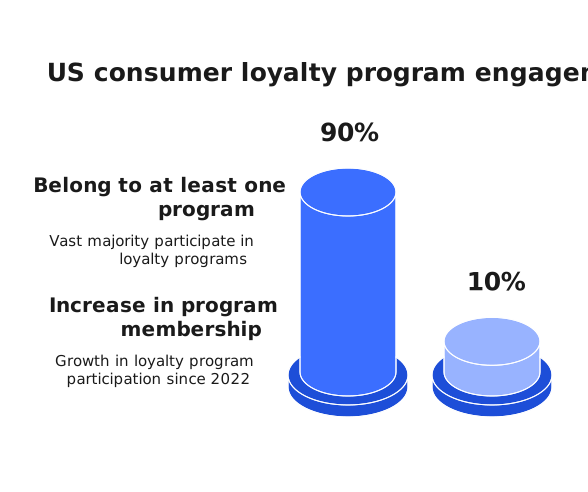
- 90% of US consumers belong to at least one loyalty program
It’s official: Consumers in the US love their loyalty programs – certainly more than their counterparts in Europe, Asia Pacific, and other parts of the globe. The average US consumer belongs to over 15 programs, a 10% increase from 2022.
However, this also means the US loyalty landscape is saturated. Traditional transactions are gradually yielding to differentiated experiences as brands think in bold new directions to stand out.
The tech transformation of US loyalty programs
With acquiring new customers costing up to 10X more than selling to existing patrons and current customers spending 67% more on average than new ones, loyalty – the art and science of triggering recurring revenue – remains a key metric of business success in the US and around the world.
In 2026, however, US loyalty programs will have a very different look than they did even five years ago, thanks to sweeping technological disruptions, including generative intelligence (AI), machine learning (ML), smart devices, and connected systems.
Loyalty programs in the US today must address the rapidly evolving expectations of the new customer, who is accustomed to ‘Amazon-like’ digital experiences and an ‘Always On’ social ecosystem.
As a pivotal cog of the customer experience (CX) strategy of the business, modern loyalty programs must not only acknowledge transactional loyalty but also prioritize emotional loyalty (here’s the difference between these two) that translates into deep, enduring relationships.
This involves creating purposeful interactions and personalized moments across an interconnected landscape of physical and digital touchpoints.
Technology is fuelling the evolution and helping brands achieve those rewarding – if challenging - milestones. Helping them harness the true potential of technology are emerging loyalty mechanisms, including Loyalty Analytics, Artificial Intelligence, and personalized marketing.
Together, these forces are revolutionizing key customer metrics such as convenience, access, personalization, engagement and real-time fulfilment across omnichannel environments.
Digital platforms are helping loyalty leaders unlock the power of databases, while smartphones seamlessly extend the experience by bundling offers directly within mobile apps.
The rise of AI-powered loyalty
The soil is ripe for the AI-fication of loyalty
Advancements in machine learning and natural language processing models, in tandem with an explosion of data, have created a fertile ground for AI algorithms to take root, helping loyalty teams uncover pearls of information and gems of wisdom about prospects and patrons.
How exactly does AI work in loyalty?
AI engines employ behavioral psychology models, track the consequences of actions, and mimic how humans learn. They utilize Graph Neural Networks (GNN) to monitor the complex web of customer interactions across online platforms and digital channels in real-time, identifying what truly matters: attention mechanisms, influencers, and key loyalty drivers.
This lets loyalty managers continuously adapt strategy, tweak response and refine rewards systems.
Rewiring loyalty programs inside out with AI
The upshot is a comprehensive reformatting of loyalty fundamentals like customer experience, on-the-go decision making (75% of business captains look up to AI for making better decisions), and the ability of a loyalty program to scale fast. The results are felt across KPIs like customer satisfaction, advocacy, and retention.
Generative Artificial Intelligence (Gen AI) is also leveling the playing field by helping leaders break the linear growth model and the restrictions of resource limitations.
AI is playing the role of an equalizer by allowing traditionally data-poor companies to approach new markets and audiences with access to generative data, and get started on their digital transformation journey confidently and cost-effectively.
So, how loyalty trends are evolving across the US
Let’s take a closer look at how technology and artificial intelligence are driving transformational shifts across both core and emerging areas of loyalty, unlocking novel new possibilities.
1. More potent loyalty analytics
Data analytics - comprising data collection, analysis and visualization – has been a bedrock of business strategy and loyalty programs for a while now, helping teams navigate the challenges of creating seamless customer experiences in a privacy-first world.
With the coming of AI - Machine Learning (ML), deep learning and neural networks in particular, loyalty analytics has experienced a tectonic shift in areas like process optimization, computing power, and operational efficiency.
Loyalty-Tech enables the identification of meaningful signals from vast amounts of data, models complex phenomena such as consumer behavior and supply chain dynamics, thereby transforming loyalty analytics from an exercise in retrospective evaluation into a predictive, forward-looking instrument of growth.
In 2026, loyalty analytics hits the next level by:
- Crunching multimodal data (text, video, voice) and mammoth datasets at scale to become more dynamic, responsive, and personalized.
- Processing unstructured data, such as curated from social media posts, call transcripts, and random emails, is particularly beneficial for the majority of businesses that don’t have an official data management program.
- Targeting customers better via dynamic segmentation and nuanced micro-segmentation of audience personas to create fluid customer categories closely aligned with shifting user preferences.
- Excelling at Propensity Analysis: Isolating ‘intent vibe’ and capturing interest signals across multi-channel data sources for better behavior, demand, and trend forecasting.
- Parsing historical data and employing predictive modelling to identify future behavior and emerging opportunities.
- Triggering the right behaviors and actions helps both members and brands achieve their targets.
- Analysing customer feedback and user sentiment to predict churn and deploy pre-emptive interventions.
2. More profitable loyalty management
Leading CRM platforms, such as Salesforce, Loyalife, and Adobe, are steadily enhancing their tech and AI stacks for improved efficiency and higher performance.
Loyalty management across industries in the US is now far more aligned and responsive to profit drivers, directly impacting growth KPIs by:
- Enabling agile, data-empowered decisions by decoding customer data in real time and providing timely nudges and alerts.
- Transforming efficiencies, reducing operational complexity, and removing errors by doing the heavy lifting, particularly for businesses with large customer databases, through automation of key chores like points tracking, points allocation, and points redemption. AI tools can also automate data curation tasks, such as surveys, inspections, and quality control mechanisms, as well as functions like resource allocation.
- Scaling frictionlessly via streamlining, simplification, automation, and amplification.
- Elevating loyalty economics through better earn-burn predictions of points.
- Making supply chains more agile and efficient via predictive analytics.
- Mitigating risk factors, strengthening security, and ensuring privacy via counterfeit detection and pre-empting fraudulent activities.
- Lifting customer lifetime value (CLV) and loyalty program ROI through increased bandwidth, better cost efficiency, and by doubling down on actions that drive high outcomes.
3. More sticky customer experiences (cx)
A PwC study reveals 73% of customers consider their experience with the brand key to purchasing decisions, while 86% of buyers are even ok to pay more for better CX. There’s clearly room for improvement, though, as a study from Deloitte Digital also indicates that as many as 50% of consumers consider their brand interactions entirely or somewhat ‘off target’.
Loyalty programs in the US are increasingly turning to technology to solve the customer experience (CX) puzzle, creating intelligent, immersive customer moments that enhance client experience and retention.
AI is removing the customer-to-brand disconnect by upending comfort, speed, availability and accessibility – factors cited by 77% of US consumers surveyed as key to purchasing decisions, and something they are willing to pay up to 5% for.
Transformative disruptions in CX include:
- Stepping beyond One-Size-Fits-All strategies to hyper-individualizing the customer arc.
- Harmonizing physical and digital touchpoints on a united and consistent framework.
- Transforming product discovery via context aware DIY type search; 81% of consumers consider self-service important.
- Hastening the rise of the ‘Answer Economy’, a ‘zero click’ state where users no longer have to click endlessly for what they are looking for. 60% of EU and US Google searches already result in zero clicks.
- Eliminating delay in points earning and rewards disbursement to enable near real-time gratification.
- Self-service kiosks and low-friction checkouts integrated with authentication and payment gateways.
- Synchronized, always-on, omnichannel experiences that let users engage with the brand at a medium, format, and time of their choice.
- Scheduling calls, demos, and other actions around one’s own schedule, not the brand’s calendar.
- Asynchronous conversations are synced on a single timeline that eliminates the need for over-authentication (such as filling the same form twice) or having to repeat details to a new support agent (because the work shift has changed).
- The evolution of Virtual Assistants from being a brand asset to a true personal assistant of the user.
- Third-party conversational integration to enhance customer engagement.
- Creating wow-worthy moments: For example, Mixed Reality experiences (AR + VR) that overlay digital information, such as product backstory, pricing and discounts in local currency or points, atop physical products and supermarket shelves, when scanned on mobile.
4. More meaningful hyper-personalization
Modern consumers want to feel understood and valued as real, flesh-and-blood individuals, not persona buckets inside a GTM roadmap. Not surprisingly, companies that excel at customer intimacy witness brisker revenue growth (McKinsey).
Brands that prioritize personalization are 71% more likely to report higher customer loyalty, according to a Deloitte study.
Amazon's intuitive product recommendation feature (including the pioneering ‘others also bought’ feature), Spotify's individualized playlists and Netflix's bespoke movie suggestions – all based on historical behavior parsing and pattern breakdown - are all iconic examples of personalization, a top trend in US loyalty in 2026.
AI raises the personalization game up several notches by:
- Generating finer metadata to nourish personalization engines.
- ‘Reading the mind’: Online conduct parsing and social connection analysis to anticipate needs, wish lists and occasions, and generate timely offers, accelerators and activators.
- Personalizing recommendations that go beyond mere persona-match to actual personality-match. Stay tuned: In the near future, Quantum AI will be personalizing in real time to unlock uncharted possibilities in US loyalty programs.
- Understanding tone and intent to meaningfully contextualize upsells and cross-sells.
- Building intuitive touchpoint dynamics through Sentiment Assistants.
- Reimagining redemption by suggesting best options that are mapped to lifestyle and preferences – particularly useful when customers have a wide range of products and experiences to choose from (Case in point: Loyalife features over 10Mn redemption choices curated across industries and available in 175+ countries).
- Cracking the holy grail of (A) intense individualization balanced by (B) strong privacy protocols.
- Creating thoughtful delights - such as a surprise birthday menu inspired by the member’s culinary posts on Instagram, or an indulgent suite upgrade based on the member’s spending tier and stay preferences.
Pro tip: Personalization carries different connotations for different customers, and a creative approach is the key.
Target’s app will helpfully point to the exact supermarket shelf that holds that special South American garlic bread you’ve been planning to buy all week, building confidence in members to expand their shopping geography and walk into Target stores even in unfamiliar neighborhoods.
US fast food giant Wendy’s is using AI to individualize the customer experience on its app. Tesco leverages predictive analytics to tailor promotions and offers based on individual shopping styles.
5. More addictive gamification
Gamification refers to the tactic of transforming routine rituals into engaging activities and interactive challenges that keep users competitively engaged, utilizing progress bars and leaderboards.
Gamification can maintain consistently high motivation levels with recognition instruments such as badges, trophies, and leaderboards. When strategically linked with loyalty mechanisms and business goals, gamification can drive the desired behaviors effectively.
Duolingo uses gamification to tailor lessons to the interest and expertise level of users, ensuring continuous engagement and non-stop progress.
AI is steadily revolutionizing the gamification experience in US loyalty programs by:
- Adjusting content and tweaking difficulty levels in real time according to the user’s performance.
- Helpfully sharing tips and suggesting individualized improvement paths (based on real-time feedback and adaptive learning) to improve performance and score seamlessly.
- Integrating peer-to-peer coaching to diffuse and distribute learning from top-performing users.
- Deploying Video Assisted Referees (VAR) for fair performance monitoring.
- Automating tasks like progress tracking and disbursement of points and rewards.
The hidden opportunity in USA loyalty
A Capgemini finding reveals most loyalty programs are failing to keep up with the pace of digital disruption.
- As few as 11% of loyalty programs personalize their rewards based on data.
- Only 24% of loyalty programs allow for redemption via mobile.
- As many as 97% of loyalty programs are designed purely around transactions and purchases.
While the number of apps continues to grow, engagement is steadily declining, and loyalty has dropped by 20%. Proof? Only 60% of surveyed consumers are happy with the current level of personalization in their loyalty programs.
Here’s the big, bright side.
US consumers – despite the saturation - remain open to new programs, and are even willing to pay for one if they think the value is correct. U.S. Loyalty program members are showing a growing appetite for subscription or fee-based loyalty programs.
And they tend to be most loyal to memberships they have paid for - services like streaming (Amazon Prime), online gaming, media, and news. The message for loyalty leaders and new aspirants? Think different.
Do you run a loyalty program in the US?
Achieve a breakthrough in your loyalty program with Loyalife’s AI-powered solutions
Reimagine possibilities and reboot impact with Loyalife’s AI driven loyalty analytics. Tailor your loyalty program around customer expectations and personality highlights with deep data, predictive modelling and automation.

Delight omnichannel customers with the world’s largest AI-ML assisted redemption marketplace featuring 10M+ rewards options across 30+ categories spanning both transactional winners (products) and memorable novelties (experiences).
Xoxoday is trusted by global names like Coca-Cola, AT&T, and Mercedes-Benz. Book a demo here.
What are the other loyalty trends you must know about?
Let’s now take a look at some of the other shifts reshaping the us loyalty skyline in 2026.
1. Mobile first
70% of customers are more likely to join a loyalty program if they can access it through their mobile device, while 51% are likely to use a mobile loyalty app when they are shopping.
Even if customers like a brand, 50% of them will stop visiting its website if it isn’t mobile-friendly, while over 50% of customers won’t even recommend a business with a poorly optimized mobile site. (Source)
Apps enable users to sign up, track points, and redeem rewards, all without losing momentum. They also store digital receipts for later use, align with payment networks for on-the-go pay, enable real-time communication (via push notifications and in-app messages) between brand and member, and allow for easy social sharing.
When it comes to loyalty programs, mobiles are the ultimate Swiss Army Knife type all-in-one tool that’s purpose-built to complete the last mile of convenience, and close the personalization loop.
Apps make perfect sense for the business, too, delivering a slew of powerful advantages to US loyalty leaders. Some of them are immersive engagement (with time-targeted, persona-synced messaging and in-app games), data-driven insights into customer behavior, personalized marketing opportunities and expanded, cost-effective reach – all over a practically ubiquitous instrument (everyone has a mobile!).
2. Embedded loyalty
Embedded loyalty adopts cutting-edge technologies like Web3, AI, and others to interconnect loyalty, rewards, and financial services. It incorporates behaviour and rewards into everyday transactions rather than treating them separately.
The Apple Card, for example, integrates into Apple Pay and Apple Wallet to create a seamless experience, encouraging spending within its ecosystem.
US brands can leverage the tactic to boost engagement and create additional revenue streams by providing value-added services; A customer, for instance, can earn embedded loyalty incentives for opening an account or taking a loan.
This boosts the member experience while creating additional revenue streams for the brand. Embedded loyalty is simple, customized and immediate - feeding into craving for hyper personalization and quick gratification.
3. Instant gratification: Show me the honey!
Quick rewards generate a feeling of fulfilment while creating an addictive loop we feel compelled to revisit again and again, establishing a bond with the brand; a tiny increase in customer retention can snowball into 95% more profits. Loyalty programs giving away instant benefits witness a 35% spike in customer spending and retain users 5% better.
That sudden craving for gum at check-out? That app game that gets you a free coffee every time you cross a level? That free sample that lets you try the product even before launch (and way before your bestie)? It’s your instant gratification hormones hollering for their happiness fix right now!
2026 is a year of AI fuelled instant gratification. The trick is to create a mixed rewards program blending big celebrations that can come later, with small joys that can’t wait.
4. Flexible earn and burn
US customers want to be rewarded in various flexible ways, not just through shopping and transactions. On cue, brands are letting patrons earn points by sharing hashtags, consuming brand content (videos and webinars), and community belonging (Lululemon and Sephora both excel at this).
Participating in cause-related activities, joining pulse surveys and focus groups, offering opinions on trends and current events, advocating and referring other customers, completing certain actions, visiting certain locations, inviting friends to participate in games and various other innovative ways. Not just earning - members of loyalty programs in the US also want autonomy over how they spend their points.
Organizations like Gap and Shell are responding with an entire network of brands (in Gap’s case – Athleta, Banana Republic and Old Navy) to give patrons an ever widening platter of choices to shop and redeem from.
M&M’s showcased its playful personality by rewarding members for an iconic sleepover at M&M’s World in Times Square. And The North Face has a highly flexible loyalty program that lets US members pick up points from every purchase with practically zero parameters and restrictions.
This is a cue for US loyalty leaders to remember that while loyalty is earned at the time of checkout, it is nurtured and celebrated throughout the year. This is their opportunity to cut through the sameness of the US loyalty market, where a disproportionate skew towards discounts and weak value propositions is causing 91% of consumers to feel that most loyalty programs are similar, offering little to no differentiation.
Organizations must highlight the aspects that make them truly distinct - the depth of their values and character, their repertoire of personal attributes (such as a sense of humor), or the causes they stand for.
5. Interoperable partnerships
This is almost an extension of the last point – variety and range of options. Customers love it if by patronizing one brand, they can pick up points from another. In fact, they are more loyal to programs when the company collaborates with partners that offer a seamless product or purpose fit.
It makes it easy for customers to use their loyalty points flexibly as needed across multiple merchants, expands their rewards options, and ensures that no transaction is wasted.
Delta Airlines allowed members of their US loyalty program to earn SkyMiles every time they bought coffee at Starbucks, an idea that became a huge hit, generating a million linked accounts in just 16 Days.
The Canada-based Air Miles program, on its part, allows members to earn and redeem awards across over 300 brand,s including Apple, Hilton, Amazon Canada, and others.

Partnerships between complementary and non-competing brands is a fast rising star of the US loyalty sky. It’s a win-win; while members get expanded choice, participating brands get to collaboratively share operations, tech and marketing infrastructure and expenses, making for a cost-efficient model for everyone. They also get access to a far bigger prospect pool than they could reach alone.
Nearly 50% of corporate respondents in a survey admitted they have plans to create an extended rewards ecosystem by investing in strategic partner networks (or by expanding their rewards portfolio across categories). The trick to success is to identify and play in the sweet spot where the interests and passions of the diverse audience sets overlap.
6. Mini rewards, micro redemptions
US loyalty programs today are not just synonymous with aspirational categories like airline tickets and hotel stays. Loyalty members are increasingly seeking windows and opportunities for micro-redemptions linked to everyday spends like groceries and gifting that don’t need high points balance, making loyalty programs a practical strategy for more and more categories.
The signal isn’t lost on loyalty planners. Brands are actively exploring tie-ups, like Mastercard and Xsolla did through their recent in-game payments solution.
7. Points as currency
Micro redemptions that can run on relatively low ‘points balances’ not only bring the entry barrier down for both the company and the participating member – it is also leading to another new trend: The adoption of points directly as currency. As embedded payments become more the norm than the exception, loyalty points are being integrated with digital wallets to aid redemption in non-traditional environments.
8. Points pooling
Pooling points lets members combine points with other members, or simply transfer points from one member’s account to another. Emirates Skywards lets family members add up points from different individual accounts.
The Flying Blue program from Air France lets small nuclear families flexibly combine miles with one another. Hotels like The Hilton allow members to transfer points into a common pool. A trend that’s efficient, practical, popular.
9. Non-expiring points: When points die, so do relationships!
Your customer is raking up points, but it’s been a while since they redeemed them. Should you add a deadline or expiry date to the rewards that stirs them to action?
Unused points are a liability to the business balance sheet, and your accounting department might take to the idea of a rewards expiry clause with enthusiasm. So might marketing, with the hope of triggering FOMO – the Fear Of Missing Out.
Human emotions, however, can be complicated; they can’t be forced to follow the linear calculations and funnels that marketing departments elaborately lay out for them. Bottomline? There could be several reasons, including prolonged mood swings, why your customer hasn’t redeemed those points yet.
Points are supposed to say ‘Thank you’ and build a relationship. Gratitude doesn’t come with an expiry date, and neither should your rewards and points. US loyalty program members hate points vanishing before they could use them – indeed, it is the No.1 frustration of 47% of users - but they might find the idea of being constantly pushed and prodded to redeem them even less agreeable.
Conditions and restrictions can be a turn-off. Instead, do what Chick-fil-A does: Let your customers take their own sweet time by adopting a non-expiring strategy. In the meantime, utilize the opportunity to diagnose possible reasons behind the low redemption rate – you may find a gem or two your analysts missed.
10. Tiered rewards
Tiered loyalty programs play into the itch for exclusivity, and the hormone high of getting stuff ‘others can’t lay their hands on’. Tiered loyalty is all about red carpets and VIP treatment, premium offers, members-only access, early access, backstage passes, limited-edition experiences, and personalized privileges.
Brands can combine point thresholds with fun gamification moments to keep members constantly vying for the next higher level or tier.
Sephora’s highly successful Beauty Insider program and Marriott’s industry-leading Marriott Bonvoy are both excellent examples of US loyalty programs that offer aspirational status levels and elite, tiered benefits.
What do US customers want from their loyalty programs in 2026?
While they still love discounts, cashbacks, and points, US consumers in 2026 are chiefly using loyalty programs to:
- Make everyday chores easy
- Indulge instant gratification pangs
- Reinforce status
Loyalty behaviour by demographic
High earners are, depending on the industry, 5% to 10% more engaged in US loyalty programs than their counterparts in a lower income bracket. Folks with lower incomes, while less engaged, tend to be 5% more loyal (on average) to loyalty programs they are subscribed to.
Entry of new players
Loyalty programs in the US are no longer the monopolistic preserve of airline and hotel brands. New categories and mini markets are exploring the playground with keen interest.
With tech and digital tools simplifying operational complexities and significantly reducing the entry level, gas stations (like QuikTrip), concert and show organizers, small and medium-sized enterprises, and even mom-and-pop stores are all vying for a share of the US loyalty pie.

Thumb rules for revamping your loyalty program with a touch of tech
Want to implement some of the trends we discussed in your loyalty program? Way to go! Just make sure to keep these caveats and considerations in mind.
1. Ensure data integrity
AI is only as good as the quality of data it feeds on. To get your data right, ensure you have clarity on the big goals you are trying to achieve and the nuances of the behaviors you are trying to capture.
Secondly, ensure your data is complete, relevant, and free from bias. Finally, train your loyalty teams on data integrity practices.
2. Prioritize privacy protection
69% of customers appreciate personalization, but only as long as it is based on data that they have explicitly shared (Source). Stay transparent. Build trust with multi-factor authentication, strong encryption, and access controls. Convey to members exactly how you intend to use their data.
And last but not least, remember that modern privacy models involve sophisticated digital architectures, so consider roping in experts or exploring a digital platform instead of trying to fix things in-house.
3. Remove silos to unlock synergies
Design your loyalty program as a cross-functional, collaborative initiative that pools participation and insights from sales, marketing, IT, strategy, accounts, and customer success to synergize learnings and compound outcomes.
This involves creating superior Total Experiences for all stakeholders that combine CX (customer experience), UX (user experience), and EX (employee experience).
4. Make room for learning
In a Gartner study, customers confided that if they “realized something new about their needs or their own goals” they were 1.73 X more likely to buy more. New technologies and systems often come with microlearning paths that may cause some initial friction in adoption.
Stay patient and treat them as opportunities for your customers to ‘experiment and grow’, which also builds appreciation and attachment with the brand.
US loyalty leaders – tick your big boxes with Xoxoday Loyalife
10X impact by revamping your loyalty programs end-to-end with omnichannel, AI-powered loyalty frameworks.
Secure, scalable, and purpose-built for enterprises, Loyalife manages every touchpoint in your loyalty journey - program configuration to member engagement to monitoring and management – from a single solution. Xoxoday Loyalife is plug-and-play, designed to sync seamlessly with nearly every workflow and tech system.

Discover the loyalty program that drives your unique KPIs and delivers measurable impact.
Power customer engagement, retention, and revenue with analytics-driven loyalty programs designed for your industry’s unique needs.