Why Emotional Loyalty Matters in Commerce, and How to Implement It
Loyalty built on deals fades. Loyalty built on emotion lasts. This blog examines how emotional loyalty transforms casual buyers into lifelong devotees, driven by a sense of purpose, trust, and deeply human connections.

On this page
Loyalty in business has traditionally been associated with rewards, such as points and promotions. While that serves short term goals, it fails to build attachment that goes beyond the surface, which is what true loyalty must do.
Some brands are now coming around and doing precisely that.
They are leading with the heart, not the wallet, by wearing their big purpose on their sleeve, supporting causes that are dear to customers, and rallying communities around missions.
These brands are pivoting their raison d’etre (reason for existence) around the theory forwarded by Harvard Business School professor and author Gerald Zaltman that says 95% of all purchase decisions are triggered from a place of emotion.
The big idea? Establish strong roots of trust that trigger subconscious favoritism bias for the brand, and establish a dedicated association dynamic that supersedes fleeting trends, marketing gimmicks, and pricing strategies.
The goal isn’t just loyalty, but sustainable loyalty—a broad niche of emotion-driven engagement slated to reach $12.1 billion by 2030 (Source).
Emotion evokes the strongest kind of loyalty, one that fuels long-term business growth and quietly renders rivals less relevant. In this comprehensive step-by-step guide that’s meant for both first-time triers and experienced loyalty teams, we cover:
- What exactly is emotional loyalty?
- How is it different from other forms of loyalty?
- The advantages of an emotional loyalty program for brands.
- How to implement a high-performance emotional loyalty program in any business.
- Industry examples and success tips.
What does emotional loyalty mean?
When attachment stems from factors such as price and discounts, customers stay loyal only as long as they don’t find a better deal elsewhere. Emotional loyalty does the exact opposite; it makes customers patronize a business even if it isn’t the most economical or ‘correct’ choice, making the decision seem irrational to others.
Definition of emotional loyalty
Emotional loyalty is a deep-seated connection between a brand and an individual that influences purchase decisions based on feelings rather than material considerations.
Emotional loyalty is nurtured by:
- Authentic engagement
- Shared purpose
- Great customer experiences
An effective emotional loyalty program positively impacts:
- Customer retention and high CLV (Customer lifetime value)
- Increased ROI with predictive revenue
- Brand advocacy and positive PR buzz
Emotional loyalty builds ‘brand energy’ – step no. 1 in stimulating behaviours that matter.
The quickest hack to the heart
In a noisy world, brands win when they play the role of a mirror, not a megaphone.
In a hyperconnected age that can feel overwhelming and confusing, what customers need is a brand whispering to them, “You’re not alone, I feel you!” By making customers feel seen, heard, and valued, a brand can sidle into the inner sanctum of the buyer’s mind - a private space where only a cherished few are allowed.
Dove’s Real Beauty campaign focuses on self-acceptance and body positivity – a powerful sentiment that directly affects many women but is not easy to talk about in public. The campaign quickly struck a chord with the company’s female user base, leading to an increase in sales.
Ties born from the heart tend to be the strongest. According to Neuroscience research, behaviors and responses that have their origins in emotion linger longer in the psyche than rational ones. The brain’s reward centre rewires to interpret the brand in the same mould as a family member, and starts associating it with positive feelings.
It's the reason Blackberry continues to have a dedicated community; loyalists who still swear by the brand’s physical keyboard, robust security features, and image of a tool for serious business professionals.
Running on heavy fuel – trust
Emotional loyalty programs run on faith, one-on-one ship and principle-based rewards. They derive sustenance from points of view that both customers and the brand hold strongly.
Popular themes for emotional loyalty programs include diversity and equality, climate change, world peace, kindness to animals, and ethical practices (such as data privacy). Notably, 30% of consumers are emotionally committed to brands that share their ethical values.
Disney excels at cultivating emotional loyalty. The brand’s choice of instrument is a nod to generational nostalgia. On the Disney Rewards platform, members are entertained year-round with magical, larger-than-life experiences, including meet-and-greets with fantasy characters, exclusive merchandise, and Disney cruises. A warm, family-style approach, where special milestones are shared and celebrated, adds a personal touch.
The four kinds of loyalty in business
Loyalty doesn’t always look the same. It can stem from habit, benefits, experiences, or something deeper. Here’s a quick look at the four core types of customer loyalty and what drives each one.
1. Rational loyalty
A purely logical and transactional decision by the customer whereby they return for better quality or more savings. This type of loyalty is largely dependent on discounts, deals, and various special offers, as well as product features.
2. Behavioral loyalty
This loyalty is driven by daily habits and convenient practices. Customers prefer to do business with a particular store, on a specific website, or via a payment method simply because they are most comfortable with the process, find the technology trustworthy, or the environment friendly.
3. Experiential loyalty
Here, customers enjoy the special ambience or VIP treatment showered upon them - be it free champagne, a personal assistant, or suite upgrades. This kind of loyalty is standard practice in the tourism, travel, and luxury industry.
4. Emotional loyalty
This arises from a strong attachment to a product or brand because the latter represents a philosophy or personality that holds special meaning or significance for the customer.
Brushing up on basics: Why is loyalty important in commerce
A company cannot grow without adding more buyers. But here’s the lightbulb moment: MORE doesn’t necessarily have to mean NEW.
According to Bain & Company, companies can boost their profits by as much as 95% by simply increasing customer retention by just 5%. An article for the Forbes Business Council supports this perspective, reminding us that acquiring new customers can be up to seven times more expensive than retaining existing ones.
Loyalty resets the equation in favor of the previous customer, not the next; a readymade goldmine that is already familiar with the product or service and, other factors being equal, far easier to convert.
It all makes solid commercial sense. After all, customers who have an emotional connection to a brand are twice as likely to spend more on it (source). It’s easy to see why 90% of loyalty program owners witness positive returns, averaging 4.8X ROI on investments.
Built around the visceral emotion of self-love and discovering joy in makeup, Rare Beauty—the Millennial and Gen-Z-facing brand by Selena Gomez—was recently valued at $2 billion.
The purpose revolution
Purpose-led loyalty, a rising trend in the broader space of sentiment-first commerce, cranks the emotion quotient up several notches.
It echoes the general expectation that businesses must think beyond profits.
A study found that 94% of global consumers value companies with a strong sense of purpose.
On cue, organizations are recrafting the articulation of why they exist as they appeal to the customer’s fundamental understanding of what truly matters.
1. Toms: Addressing inequality
Footwear brand Toms donates a pair of shoes to a person in need every time someone makes a purchase from them. The gesture turns the consumer into a vehicle of social justice, a huge high.
With a ‘take-home’ that’s potentially more satisfying than the product itself, here's a perfect premise for an emotional loyalty program founded on purpose.
2. Dove: Investing in womenpreneurship
Statistics show women in business receive significantly less financial support than their male counterparts. DOVE’s InstaGrants sought to trigger a corrective discourse (and make a statement) when it rewarded winners of its campaign with a $10,000 grant along with business promotion assistance.
3. Patagonia: Saving the planet
When Yvon Chouinard said “Earth is now our only shareholder", he clarified what his company Patagonia stood for better than any company report could have: Planet, future, and sustainability.
The company showed it means what it says when its iconic ad proclaimed ‘Don’t Buy This Jacket!’, reminding buyers about the environmental impact of consumer products.
4. Nike: Unlocking potential
Nike’s big purpose is to help people believe in their ability. The brand’s tagline, ‘Just Do It,’ inspires both athletes and non-athletes to push their limits continually.
No matter how challenging the goal, the brand-endorsed path to glory—relentless self-improvement—turns it into a noble, aspirational, and achievable quest.
Emotional storytelling with powerful imagery and unfiltered narratives, solidarity with causes that have strong social resonance (such as gender equality, racial justice, and sustainability), investments in community development, and a vocal tribe of aficionados ensure that the emotional momentum never drops.
Why is emotional loyalty important in business?
Relationships constructed around non-transactional synergies, symbols, and moments map to a very different location in the brain. They add meaning to daily living, elevate our sense of self-worth, and engineer paradigms of engagement that can be sustained year-round, not just during checkout.
Airbnb’s Superhost is a recognition program for homestay hosts, but it’s not about getting more customers. Instead, Airbnb shares its unique stories on the platform and celebrates its impact. This makes hosts feel integral to the brand’s success.
By meeting an entirely different need category - validation and pride, as opposed to revenue and profits - the company connects on a higher emotional level, evoking powerful emotions like gratitude and a sense of belonging.
When members turn loyal, so do profits.
According to the Harvard Business Review, when patrons are emotionally locked in, they are three times more likely to re-patronize. In Airbnb’s case, superhosts whom the brand has recognized will be motivated to deliver even more superior stay experiences, indirectly impacting financial performance for the company.
The three stages of emotional loyalty
1. Affinity
Customers sense something distinctly different about the brand, and are drawn to exploring it. They are by no means loyal at this point, but have a definite preference and liking for the brand.
2. Attachment
The company has successfully established a meaningful bond with its customers through its unique world philosophy and approach to customer satisfaction. Customers are fairly close to ‘giving in’, but there’s still a piece missing.
3. Trust
The stage where the customer is convinced that the brand is true to its word, whether it is providing great support, respecting privacy, or endorsing a cause. Trust unlocks the highest level of loyalty, a state that brands achieve through consistent commitment and effort.
How to measure emotional loyalty?
Emotions don’t show up in spreadsheets—but they leave clear signals if you know where to look. Measuring emotional loyalty means tracking both what people say and how they behave, across moments that matter.
1. Just ask. Sentiment surveys, focus groups, one-on-one chats, emails, in-app notifications, and WhatsApp are great ways to get a first-hand load of what customers think about you.
2. Scores like NPS (Net Promoter Score), CSAT (Customer Satisfaction Score), and BLQ (Brierley Loyalty Quotient) will offer helpful insights.
3. Engagement metrics on platforms such as the company website, loyalty program microsite, and social media can shed light on key performance areas.
Some of these include direct traffic (not via search), time spent on the platform beyond purchase transactions (on activities like games, polls, and consuming content), participation in community dynamics, sharing on social media, contributing user-generated content, and so on.
4. Customer advocacy on public channels like social media - including referrals, mentions, and reviews. A Harvard Business Review finding suggests emotionally engaged customers are at least 3X more likely to recommend a product or service.
5. Pay particular attention to KPIs like customer retention, churn, customer lifetime value (CLV), and others.
6. Decoding emotion can be dicey; play Sherlock Holmes and scratch beyond the surface. Emotionally invested fans tend to be demonstrative about their association. They will gush and rave one minute, then be scathing in their criticism the next if they feel let down by the brand.
Look for phrases and terms like ‘my brand’ or ‘my community’, for instance, that reveal a high degree of personal stakes.
Utilize social listening tools to analyze conversations across various funnels and platforms (app, website, social media), and leverage Behavioral Analytics to identify key signals (pride, empathy, solidarity) and decode intent.
7. Combining metrics strategically often offers enhanced clarity and reveals hidden patterns. For example, parsing CSAT through the lens of social advocacy and shopping cart activity can help identify emotion catalysts that have the most significant influence over purchase decisions.
Decode transaction patterns, understand communication impact, and amplify relationship accelerators with loyalty-first algorithms that use AI-driven predictive insights to analyze KPIs across multiple dimensions.
Book a demo with our emotional loyalty experts today.
Benefits of an emotional loyalty program
Emotional loyalty goes beyond surface-level engagement. It shapes behavior, deepens trust, and delivers value across every corner of the business. Here’s what brands stand to gain when loyalty is built on feeling, not just function.
1. Sheer commercial value
Research from Forrester and Capgemini reveals that brands that evoke customer emotions have the potential to positively impact key growth metrics, including buying frequency, category basket size, and profit.
A survey of 19,000 customers in the US and UK found that emotional attachment was the biggest driver (43%) of value, with product features coming in a distant second (20%).
82% of brand loyalists always buy from a brand, while 70% of them spend up to twice as much (source). They are also more open to exploring upsell and cross-sell options, says a Bain & Company study.
According to Gallup Analytics, companies that effectively apply the principles of behavioral economics outperform peers by 85% in sales growth, and by more than 25% in gross margin.
As per Capgemini, emotionally driven buyers can drive a 5% uplift in annual revenue.
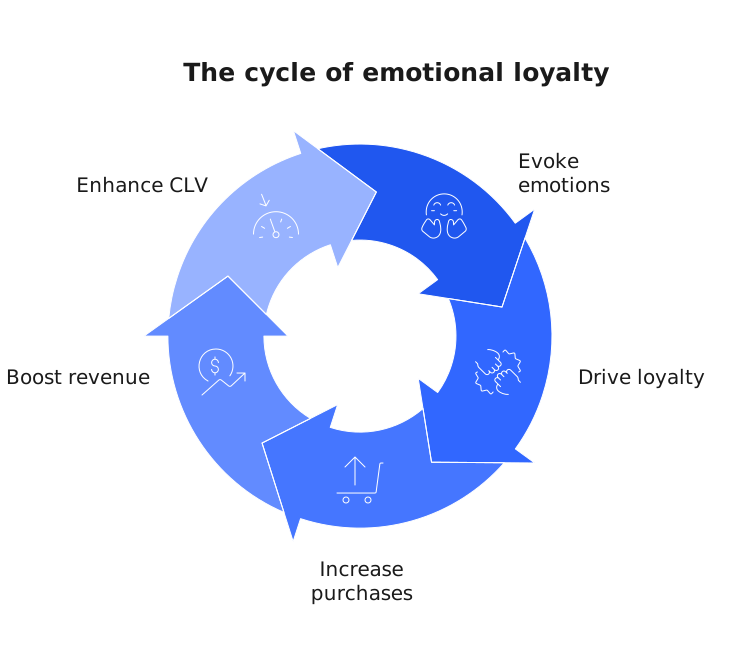
In terms of metrics, emotional connections are known to significantly increase customer lifetime value (CLV) by as much as 800% for some financial services firms, while also boosting key performance indicators (KPIs) like annual recurring revenue (ARR).
Emotional loyalty encourages more intentful product exploration, higher repeat purchases and order value, and a longer time horizon for the relationship.
2. Unrivalled competitive edge
Emotional loyalty effectively makes the competition irrelevant and the business uncertainty-proof. Blind devotion, so to speak, makes fans less critical of collateral factors like discounts, market alternatives and so on; they pick the brand as a natural reflex even when rivals are offering better deals.
According to the Harvard Business Review, emotionally engaged customers are less likely to shop around and are significantly less price-sensitive; they also require a substantial financial incentive to consider defecting to a rival product.
3. Resilience to market forces
With customers willing to stick with the brand through thick and thin, the business is effectively insured against fluxes in consumption trends and market behavior.
4. Authentic connections
The once cast-in-stone customer journey is yielding to experiences that allow customers more freedom and flexibility than ever to pick their own path towards ‘patron-hood’. This also makes them more invested in the journeys they choose.
Brands are responding by designing these pathways around relationship accelerators, such as honesty, humor, quirk, ownership of shortcomings, and openness and directness (e.g., being candid about the company's mission, sharing behind-the-scenes stories, and so on).
This creates a foundation for both parties to nurture a sustainable relationship that’s credible and genuine from both sides.
5. A higher brand of branding
Positive emotions are reserved only for those we like and trust; folks who affirm our beliefs about the world at large and make us feel good about who we are. Emotional loyalty turns a brand into a trusted life companion, not just a provider of solutions.
Brands that can foster genuine emotional rapport with customers are 3X more likely to be viewed as partners, with members looking upon them as a pillar of validation and support in their quest towards:
- Becoming a better person aligns with personal goals of self-improvement and self-actualization.
- Making the world a better place aligns with the desire to introduce positive change in society.
- Belonging to a community satisfies the craving to be part of a larger tribe of believers.
6. Greater personalization
Emotional loyalty programs require brands to develop a deep understanding of their customers, including their personality fundamentals and intrinsic motivations. They also ensure that the brand closely individualizes every aspect of the journey, ensuring recallable experiences and shareworthy moments.
7. Better engagement
Customers who love the brand will voluntarily seek out opportunities to engage with it. They want to know everything that’s going on - the latest updates, new causes the brand is supporting, marketing campaigns and partnerships, personal stories of team members (many of whom might be heroes in the eyes of fans), upcoming launches, and so on.
Marketers receive a pre-built foundation upon which to refine and improve emotional loyalty metrics through interventions and tactics such as events and gamification.
The hugely successful idea resulted in a 53% increase in app downloads, with 70% of customers stating they would recommend KFC Rewards Arcade to friends and family.
9. Advocates cum amplifiers
Emotional loyalty fuels brand advocacy, representing the purest form of devotion and a highly cost-effective mode of word-of-mouth marketing.
92% of consumers worldwide trust online customer opinions, and it is safe to assume that highly engaged fans will have a greater impact. Indeed, a Bain & Company report finds customers are four times more likely to refer friends and family to a company they are loyal to.
Advocates – admirers and cheerleaders – are a blessing for the business. They hate the thought of a world without the brand. Advocates feel personally responsible for the brand’s well-being and feel compelled to act as its benefactor and guardian. They will do everything in their power – sharing legitimate feedback and promoting it in their circles- to see the brand succeed.
What is an emotional loyalty program?
Emotional loyalty programs convert conducive vibes into a formal mechanism and structured process that inspires desired behaviors and rewards effort. Uniquely differentiated features spur repeated interaction between brand and customer, solidifying the bond a little more every time.
LEGO already has a sticky global fan base. Its loyalty program LEGO Insiders flywheels the love. On the platform, members can display their creativity, sign up for challenges, and learn about designing.
Watching their ideas come to life satiates the urge for accomplishment, while public spotlight and praise closes the emotional loop with validating recognition. Rewards come in the form of intriguing meet-and-greets and factory tours, making for a novel experience.
What’s more, members can submit proposals for new LEGO sets (while voting for ideas submitted by fellow creators) – underlining the company’s faith in the passion and potential of its fans, and its innovative method of integrating them into the core product experience.
How to build an emotional loyalty program for your business or brand?
A report by The Drum shares good and bad news. The good news is that a robust 52% of consumers actively engage with loyalty programs. In fact, the number of programs patronized by US consumers has risen by approximately 10% in recent times.
However, this comes with a flipside. An inordinately high number of loyalty programs - 77% to be precise - also fail within the first two years.
The reason? Most of these companies take a transactional approach to loyalty. They focus on me-too discounts, deals, and free stuff.
With things like cash and goods as its only distinguishing factor, a loyalty program will always walk on thin ice. And lose members the moment a rival offers a more attractive freebie or a larger discount.
So what should these brands be doing instead? Four words: Build. Long. Term. Glue.
Here’s how.
The five fundamental stages involved are:
- Build trust through authentic associations.
- Glean customer insights through these associations.
- Build a customized loyalty program on the foundation of insights and relationships.
- Enhance the program with feedback from the most loyal customers.
- Keep the flywheel spinning by consistently delighting them with rewards, experiences, and surprises.
The loyalty-building process
Combine the three forms of loyalty - transactional, behavioral, and experiential - while adding authenticity, CX, and consistency, to arrive at a desired state of emotional loyalty.
- Build comfort levels with transactional and behavioral convenience.
- Build resonance with relatable purpose, authentic approach, and excellent customer experiences.
- Build trust by repeating with consistency and intent.
While designing an effective emotional loyalty program for your brand.
1. Find out what matters to your customers
Apply loyalty analytics on detailed customer data sets to identify the values, issues, and motivations that matter deeply to the company’s most valuable customers.

For Millennials and Gen Z, brand loyalty is often inseparably linked to identity. 79% of Gen-Z customers love the idea of loyalty programs, and 54% would leave a brand for one that supports a cause they care about, even if it costs more.
2. Be clear on the space you want to own
What does the company stand for? Clarity here will help identify the emotions you want to be known for, and evoke corresponding behaviors in your customers.
Make a short list of causes or themes that most naturally align with the company’s journey.
Endorsing them is a natural fit, while sitting well with employees and stakeholders.
3. Locate the intersection
This is the key step. Find out the overlap between your customers’ motivations and your business philosophy. That’s the sweet spot your loyalty program needs to own. It shapes the big value proposition of the program, articulates long term benefits for customers, and informs key tentpoles.
4. Identify the accelerators
Leverage statistical modeling and survey predictions to link behavior and motivations with favorable behaviors such as purchases and referrals. This will enable you to identify and isolate emotions that are most beneficial to the company. Design key loyalty program mechanisms and KPIs around them.
5. Create a framework that’s multi-dimensional and holistic
The different modes of loyalty – transactional, behavioral, experiential, and emotional – complement and augment one another. Blend them to create a framework that is balanced, sophisticated, and comprehensive.
For instance, emotional resonance can be reinforced through tangible benefits and memorable experiences, which assure customers that the program's value proposition isn’t just fluff.
The convenience, familiarity, and instant gratification of transactional and behavioral loyalty programs - along with the fact that they are easy to implement and manage, and also provide data collection opportunities – make them a practical starting point to build an emotional loyalty model.
6. Personalize the customer experience
The entire premise of an emotional loyalty program rests on “I know who you are and what you want”, which makes personalization and customer experience (CX) key to program success.
Every promise and gesture from the brand must support the claim that it truly gets its customers, from their desires to their preferences to their motivations (both extrinsic and intrinsic).
Companies that excel at customer intimacy witness brisker revenue growth (McKinsey). In fact, brands that prioritize personalization are 71% more likely to report higher customer loyalty, according to a Deloitte study.
Why customer experience is a make-or-break
A PwC study reveals 73% of customers consider their experience with the brand key to purchasing decisions, while 86% of buyers are even ok to pay more for better CX.
Some ways emotion-first loyalty programs can crack the personalization puzzle are:
- Thinking beyond one-size-fits-all to individualize the customer arc intensely.
- Analysing social attitudes and dynamics to anticipate needs, wish lists, and occasions where the brand can deploy strategic accelerators and activators.
- Personalizing recommendations in real time that go beyond mere persona match and are a true ‘personality match’.
- Building intuitive touchpoint dynamics through sentiment assistants.
- Harmonizing physical and digital touchpoints for a consistent, omnichannel experience.
- Embedding real-time feedback mechanisms across the customer journey.
- Creating thoughtful delights, such as an anniversary menu inspired by the member’s culinary stories on Instagram, or an indulgent airline seat upgrade based on the member’s spending tier and stay preferences.
- Reimagining redemption by suggesting best reward options that are mapped to lifestyle and preferences.
- Eliminating delay in points earning and rewards disbursement to enable near real-time gratification.
- Respecting members’ privacy through strong security protocols.
It generously customizes orders with extra shots and sends birthday rewards, making members feel like the brand truly knows them and cares about their happiness. Not surprisingly, for many, ‘coffee at Starbucks’ is less of a drink and more of a ritual.
7. Go off script, now and then
86% of emotionally engaged consumers expect brands to reciprocate their loyalty in ways that go above and beyond loyalty programs (Source). An emotion powered loyalty program needs to keep surprising fans and catch them off guard with heartmeling gestures and novel experiences.
Taco Bell sent a fan over the moon by actually delivering his ‘wild request’ for a customized Taco Bell Speedo with ‘Outside the Buns’ – a franchise slogan – etched on the reverse.
Beauty Squad from e.l.f. Cosmetics continues to surprise fans pleasantly with unexpected offers, birthday delights, and fantastic deals. That the brand stands for vegan, cruelty-free products helps build proximity with a young generation.
When pop artist Normani posted on social media that her hot sauce was confiscated at the airport, hot sauce company Tabasco responded by sending her hundreds of TABASCO® Minis – creating a moment that got a nod from their fan community and continues to be a mini case study for marketers.
8. Be great at good old customer support
Happy interactions reinforce attachment. 83% of emotionally engaged consumers confess their loyalty will increase after a positive interaction with the support team.
9. Remember: Data above all
The effectiveness of a one-on-one relationship dynamic hinges squarely on the quality of the data.
Emotional Loyalty leaders must establish a modern data management system, train teams on loyalty analytics, and insist on robust data integrity practices.
Loyalty managers must prioritize collecting, integrating, and maintaining high-quality data by trawling a diverse range of sources – including customer touchpoints, polls and surveys, internal CRM and CMS platforms, retailer and distributor networks, third-party brokers, and others.
The data should sport a healthy mix of transactional, behavioral, and emotional parameters.
Use statistical models and regression analysis to analyze correlations between variables, which will help understand the leading factors and triggers driving customer loyalty for the brand. This understanding will inform product and marketing efforts.
Patience is profitable: Complex correlations become apparent over time. Data initiatives should therefore focus on long-term signals and patterns.
Compliance with data protection regulations like GDPR and privacy protocols is a given and must be strictly adhered to.
10. Match expectation with delivery
Hollow gestures and failure to live up to one’s word can be fatal in a space that runs on the force of trust and principles. 34% of shoppers have switched from a brand they were once loyal to because the brand failed to meet its commitments.
Brands can bridge the gap by setting realistic expectations, avoiding tall claims, doing the small things right, and staying transparent to a fault.
11. Build it and they will come
We’re talking about your brand’s community, of course – the hub where the action and emotion unfold.
Amplify belonging by building a tribe. A loyal community flywheels program outcomes with free publicity and reputation, content acceleration and distribution, spot-on feedback, referrals and more.
Here are some ways to get started.
- Define the community’s big purpose – it must be an extension of the loyalty program’s value proposition - so that members know what to expect, are aware of behavior guardrails, and other rules.
- Create an online destination for your community – choose from a variety of forums, groups, and platforms available online today, and select one that best suits your brand.
- Craft distinctive brand content with innovative storytelling approaches. Color outside the lines to break clichés and clutter: In an era dominated by short-form content, Rare Beauty - Selena Gomez’s beauty line – is successfully experimenting with long-form narratives on Substack.
- Reward members with extra value. Rare Beauty Secret, Rare Beauty’s newsletter, regularly shares BTS (behind-the-scenes) looks that feel more ‘insidery’ than the brand’s TikTok and marketing channels, reinforcing intimacy with fans.
- Encourage user-generated content and reward social sharing.
- Brainstorm with fans to co-create and host special occasions and exclusive events. You can make a meal of the process by floating a contest; best event ideas win fabulous prizes.
- o Invite people to join the community. Not just customers and users, but also leaders, celebrities, and local influencers.
- Enter into meaningful collaborations with brands that share similar values and vibes.
- Incentive participation and engagement in the community with exclusive rewards and perks.
12. Choose the right loyalty software
Stacks and tools to make your emotional loyalty rubber hit the road with top confidence.
Let tech and tools do the heavy lifting. Pick an emotional loyalty software and platform that brings the many moving parts of your emotional loyalty program together, closes gaps of human error, and lifts efficiency with streamlined automation.
AI-powered loyalty software and systems are ushering in new horizons in propensity analysis, enabling the ability to isolate intent and capture interest signals across multiple channel data sources for more intelligent targeting, real-time personalization, and opportunity forecasting.
HubSpot, Loyalife, Salesforce… there are several cutting-edge loyalty software options available that address your specific needs while delivering the value you deserve.
13. But first
Even the best emotional loyalty program cannot make up for a flawed product, marketing, or service experience - so make sure the basics are in place first.
Build, launch, and scale a high-emotion, high-performance loyalty journey for customers with Xoxoday Loyalife
Loyalife brings every moving part of your emotional loyalty program into one powerful, easy-to-use system. Here's what your brand can unlock with it.
- Create sticky, personalized engagement.
- Identify top advocates and amplify program accelerators.
- Turbocharge performance with real-time data, AI-powered Analytics Suites, and dynamic reporting.
- Reward memorably from the world’s largest redemption marketplace.
- Ensure enterprise-grade privacy, security, and compliance.
- Seamlessly integrate with CRM, POS, third-party tools, and native business technologies and processes.
Xoxoday Loyalife is the world’s leading emotional loyalty software endorsed by Fortune 500 giants like Coca-Cola, AT&T, Mercedes, and more. Book a quick demo now.