

On this page
AdTech is no longer just growing: It’s exploding. With the global market estimated between USD 0.7–1.3 trillion in 2024–2025, forecasts project it reaching anywhere from USD 2.55 trillion by 2032 to USD 7.82 trillion by 2034. AI-driven optimization, real-time bidding, and outcome-based advertising are accelerating spend, but they’re also raising expectations.
At the same time, privacy regulations like India’s DPDP Act and global data protection laws are fundamentally changing how advertising works. First-party data, clean rooms, and privacy-safe measurement have become mandatory, not optional. Feature parity is rising, targeting is constrained, and trust is now a competitive advantage.
In this high-stakes environment, engagement is the real differentiator. AdTech platforms that win is those that keep advertisers spending, agencies active, publishers loyal, revenue teams motivated, and internal teams aligned, across markets, channels, and regulations. This is no longer about technology alone; it’s about building an ecosystem that performs, adapts, and stays engaged at scale.
Major AdTech companies across key regions
These companies represent the most influential players across global markets, each managing complex ecosystems of advertisers, agencies, publishers, demand-side platforms (DSPs), supply-side platforms (SSPs), and internal teams. From India's mobile-first advertising dominance to the programmatic sophistication of US buyers, each region presents unique engagement challenges that require tailored approaches.
With this landscape in mind, let's examine how AdTech companies operate differently across geographies and what that means for stakeholder engagement.
How AdTech companies operate across geographies
AdTech platforms operate in vastly different environments depending on region—ranging from mobile-first performance markets to privacy-first programmatic ecosystems. These differences influence how campaigns are planned, measured, optimized, and supported, directly shaping how advertisers, agencies, and publishers engage with platforms on a daily basis.
India
Mobile-first with performance marketing dominance. Majority of ad spend flows through mobile app advertising, in-app placements, and mobile web inventory. Strong focus on cost-per-install (CPI), cost-per-action (CPA), and performance-based pricing models rather than CPM. E-commerce, gaming, and fintech verticals drive significant programmatic spending. Regional language targeting and vernacular content advertising growing rapidly. WhatsApp and social media advertising integration critical for campaign success. Price sensitivity extreme with advertisers demanding clear ROI attribution and fraud prevention.
Southeast Asia
Video and social-first with mobile dominance. Heavy emphasis on video advertising across YouTube, Facebook, Instagram, and TikTok. Mobile gaming advertising represents significant revenue stream across the region. E-commerce platforms (Shopee, Lazada, Tokopedia) driving retail media network growth. Cross-border advertising campaigns common due to regional business expansion. Multi-language and multi-currency support essential for pan-Asian campaigns. Influencer marketing integration with programmatic buying increasingly important. Fraud prevention and brand safety concerns paramount in developing markets.
Middle East
Premium brand advertising with luxury focus. Strong concentration in luxury goods, automotive, real estate, and tourism advertising. Arabic language targeting and culturally appropriate creative requirements essential. High-value campaigns with sophisticated audience targeting and brand safety controls. Ramadan advertising represents massive seasonal opportunity with specialized campaigns. Video advertising dominance across YouTube and social platforms. Regional events (Dubai Shopping Festival, Saudi National Day) drive significant ad spend spikes. Premium publisher inventory highly valued over programmatic remnant inventory.
United States
Programmatic sophistication with data-driven decision making. Customers expect advanced audience targeting, lookalike modeling, and AI-powered optimization as standard. Real-time bidding (RTB), private marketplace deals (PMPs), and programmatic guaranteed deals all actively used. Deep integration with data management platforms (DMPs), customer data platforms (CDPs), and analytics tools mandatory. Privacy regulations (CCPA, upcoming privacy laws) creating complexity in targeting and measurement. Connected TV (CTV) and over-the-top (OTT) advertising rapidly growing. Retail media networks (Amazon, Walmart, Target) disrupting traditional AdTech landscape.
Europe
Privacy-first with GDPR compliance complexity. Cookie deprecation and privacy regulations fundamentally reshaping targeting strategies and measurement. First-party data strategies and contextual targeting gaining prominence over behavioral targeting. Consent management platforms (CMPs) integration mandatory for all advertising activities. Multi-country campaigns requiring localization across languages, currencies, and regulatory frameworks. Strong emphasis on brand safety, viewability, and ad fraud prevention. Programmatic audio and digital out-of-home (DOOH) advertising growing rapidly.
These operational differences directly shape the pain points each stakeholder group experiences in their daily interactions with AdTech platforms.
Before diving into persona-specific challenges, it's important to understand the broader behavioral shifts reshaping how AdTech companies must approach engagement:
Behavioral shifts transforming AdTech
Beyond geographic differences, AdTech is undergoing structural change. Privacy regulations, new media formats, AI-driven optimization, and evolving advertiser expectations are redefining how value is delivered and measured. These shifts increase complexity across the ecosystem and raise the bar for transparency, performance, and engagement.
1. Privacy regulations forcing first-party data strategies: Cookie deprecation, GDPR, and CCPA driving fundamental shifts from third-party behavioral targeting to first-party data and contextual advertising.
2. Programmatic advertising becoming table stakes: Real-time bidding, automated buying, and AI-powered optimization no longer differentiators but baseline expectations across all advertiser segments.
3. Retail media networks disrupting traditional AdTech: Amazon, Walmart, Target, and e-commerce platforms building closed-loop advertising ecosystems with superior attribution and measurement.
4. Connected TV (CTV) and streaming video exploding: Linear TV ad budgets shifting rapidly to programmatic CTV, OTT platforms, and streaming services requiring new buying capabilities.
5. Performance and brand advertising converging: Advertisers demanding both brand awareness metrics and performance outcomes (conversions, sales) from the same campaigns and platforms.
6. AI and machine learning expected everywhere: Automated bidding, creative optimization, targeting audience, and fraud detection powered by AI now baseline requirements, not premium features.
7. Transparency and brand safety non-negotiable: Advertisers demanding complete visibility into where ads appear, viewability rates, and protection against appearing alongside inappropriate content.
8. Omnichannel attribution increasingly complex: Measuring impact across display, video, social, search, CTV, and offline channels becoming critical for demonstrating platform value and ROI.
With these shifts in mind, let's examine the specific engagement challenges each persona faces in the AdTech ecosystem.
The engagement challenge across AdTech personas
AdTech platforms serve multiple stakeholders simultaneously, each with different goals, pressures, and success metrics. Advertisers focus on ROI, agencies on scale and efficiency, publishers on monetization quality, and internal teams on performance and reliability. Viewing engagement through a persona lens reveals where friction builds and why targeted motivation is essential.
Customers (advertisers & brands)
Who they are: CMOs, VP of Marketing, Performance Marketing Managers, Media Buyers, Brand Managers, Digital Advertising Managers, Growth Marketing Leads
Challenges they face:
- Platform fragmentation forcing management of multiple AdTech vendors simultaneously, creating operational complexity and attribution challenges
- Difficulty proving ROI and attribution across multi-touch customer journeys spanning display, video, social, and search channels
- Ad fraud concerns with click fraud, bot traffic, and invalid impressions wasting significant portions of advertising budgets
- Generic campaign optimization recommendations that don't align with specific business objectives, seasonality, or competitive landscape
- Steep learning curve for sophisticated platforms with extensive features overwhelming time-constrained marketing teams
- Poor support during campaign launches and critical optimization periods when immediate assistance is most valuable
Addressing advertiser engagement requires parallel focus on the agency partners who manage campaigns and influence platform selection decisions.
Agency partners (media agencies & trading desks)
Who they are: Media agencies, programmatic trading desks, performance marketing agencies, creative agencies with media buying, independent media buyers
Challenges they face:
- Manual commission and rebate tracking across multiple platforms causing reconciliation headaches and payment disputes
- Inconsistent incentives varying by advertiser size, campaign type, or promotional period creating confusion and unpredictability
- Limited training on new features, targeting capabilities, and platform updates affecting their ability to optimize client campaigns effectively
- Agencies inactive between quarterly business reviews due to lack of ongoing engagement, recognition, and performance visibility
- Difficult onboarding processes for new advertiser clients affecting time-to-first-campaign and initial performance results
While agencies bring advertisers and manage campaigns, publishers provide the inventory that makes the ecosystem function.
Publishers & supply partners
Who they are: Website publishers, app developers, content creators, video publishers, podcast networks, connected TV platforms
Challenges they face:
- Payment delays with net-60 or net-90 payment terms creating cash flow challenges for smaller publishers
- Lack of transparency into how their inventory is valued, priced, and performed in programmatic auctions
- Revenue optimization complexity requiring constant monitoring of fill rates, CPMs, viewability, and advertiser demand
- Ad quality concerns with malware, inappropriate ads, and heavy creative files affecting user experience and site performance
- Limited direct relationship with demand partners and advertisers reducing their ability to negotiate better rates
- Difficulty understanding which audience segments and content categories drive highest CPMs and advertiser demand
- No recognition or incentives for maintaining high-quality inventory, strong viewability rates, and brand-safe environments
Sales teams play a critical role in acquiring new advertisers and expanding existing relationships across all these stakeholder groups.
Sales teams (SDRs, AEs, enterprise sales)
Who they are: Sales Development Representatives, Account Executives, Enterprise Sales Teams targeting brands and agencies, Agency Development Managers
Challenges they face:
- Long sales cycles (45-90 days) for enterprise advertisers requiring multiple stakeholders, legal reviews, and budget approvals
- Losing competitive deals to Google Marketing Platform, The Trade Desk, Amazon Advertising, and other established players with market dominance
- Difficulty demonstrating differentiated value during demos when core capabilities (programmatic buying, audience targeting) are table stakes
- Delayed commissions tied to campaign performance or advertisers spend thresholds rather than contract signing
- Challenge converting trial campaigns into long-term committed spend before advertisers test competing platforms
Once sales closes deals, customer success teams take over campaign management, optimization, and retention responsibilities.
Customer success & support teams
Who they are: Customer Success Managers, Campaign Managers, Technical Account Managers, Ad Operations Specialists, Technical Support Engineers
Challenges they face:
- High campaign volume management with CSMs overseeing hundreds of active campaigns across dozens of advertiser accounts simultaneously
- Managing diverse advertiser sophistication levels from experienced programmatic buyers to first-time digital advertisers needing extensive hand-holding
- Campaign performance pressure with CSMs held accountable for ROAS, CPA, and other outcomes partially outside their direct control
- Limited recognition for preventing churn, successfully rescuing underperforming campaigns, or driving incremental spend from existing advertisers
- Burnout from demanding always-on expectations in a 24/7 global advertising market without structured appreciation programs
While CS teams face external pressures, internal employees drive the product innovation, algorithm improvements, and operations that power everything.
Employees (AdTech company's internal teams)
Who they are: Product & Engineering Teams, Data Science & ML Teams, Ad Operations Teams, Finance, Legal, Compliance, Internal HR Teams
Challenges they face:
- Engineering teams under constant pressure for algorithm improvements, bidding optimization, and real-time performance in millisecond auction environments
- Data science teams managing model accuracy, preventing bias, and maintaining prediction quality across diverse campaign objectives
- Ad operations teams coordinating campaign trafficking, creative approvals, and troubleshooting delivery issues across time zones
- Limited recognition for backend teams compared to customer-facing sales roles that receive commissions and public celebrations
- Remote engineering teams feel disconnected from real advertiser challenges, campaign objectives, and business impact of their work
- Innovation contributions going unnoticed without structured reward programs that acknowledge breakthrough features or efficiency improvements
- High stress during major product launches, peak advertising seasons (Q4, Black Friday), and critical system updates affecting billions in ad spending
Understanding these challenges is the first step. The real solution lies in mapping each persona's journey and designing engagement strategies for every stage.
The 5-journey framework for AdTech companies
Every stakeholder in your AdTech ecosystem moves through five distinct stages. Understanding these journeys helps you design targeted engagement strategies that drive meaningful outcomes at each phase of the relationship.
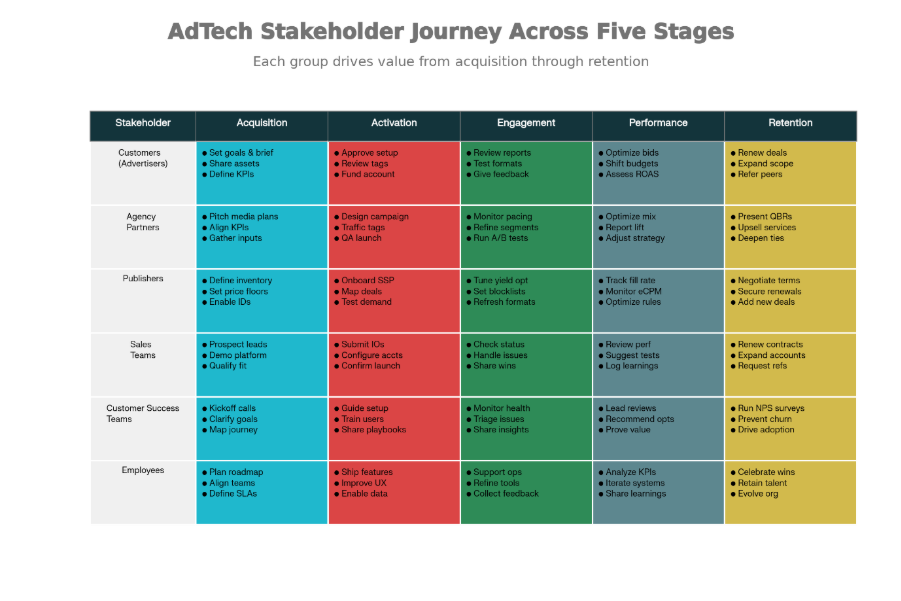
With this framework, AdTech companies can design programs that connect every interaction, reward meaningful actions, and build stronger relationships across all touchpoints from first contact through long-term partnership.
How to motivate every persona in your AdTech ecosystem?
Once journeys are defined, engagement becomes actionable. Motivation strategies must reinforce behaviors that improve campaign outcomes, revenue growth, retention, and ecosystem health. The most effective programs connect rewards directly to measurable performance and adoption milestones.
Customers (advertisers & brands)
Tier-based loyalty programs: Create advertiser tiers (Bronze, Silver, Gold, Platinum) based on monthly ad spend, campaign volume, and platform tenure. Higher tiers unlock priority support, reduced platform fees, beta feature access, and dedicated optimization support through Xoxoday's customer loyalty platform.
Performance achievement rewards: Recognize advertisers who achieve strong ROAS, exceed conversion targets, or improve campaign efficiency metrics through milestone rewards tied to business outcomes.
Advocacy incentives: Reward advertisers who refer other brands, participate in case studies, speak at industry events, or provide testimonials with ad credits and platform fee waivers via referral tracking.
Platform adoption bonuses: Incentivize exploration of advanced features like custom audiences, video advertising, or dynamic creative optimization with rewards for feature activation and usage.
Budget expansion rewards: Recognize advertisers who increase their monthly spend, expand into new ad formats, or consolidate spend from competing platforms with tiered incentives.
Agency partners (media agencies & trading desks)
Real-time commission dashboards: Provide instant visibility into managed spend, campaign performance, and expected commissions through Xoxoday's partner management solution, eliminating disputes.
Automated instant payouts: Replace quarterly rebate checks with monthly commission crediting via digital gift cards or direct deposits across 100+ countries.
Tiered partnership programs: Create agency levels (Authorized, Preferred, Premier, Elite) with escalating commission rates, dedicated support, exclusive inventory access, and co-marketing funds through automated tier management.
Campaign performance bonuses: Reward agencies whose managed campaigns achieve strong performance metrics including high ROAS, low CPA, and strong advertising retention.
Advertiser portfolio growth incentives: Recognize agencies who successfully onboard new advertising clients, grow existing client budgets, and maintain high client satisfaction scores.
Publishers & supply partners
Fast payment programs: Reduce standard payment terms from net-60 to net-30 or net-15 for high-quality publishers through Xoxoday's rewards infrastructure enabling faster cash flow.
Quality inventory bonuses: Reward publishers who maintain high viewability rates, strong brand safety scores, and premium inventory quality with CPM premiums and guaranteed spend.
Fill rate optimization incentives: Recognize publishers who successfully increase fill rates through inventory optimization, ad placement improvements, and format experimentation.
Exclusive demand access: Provide top-performing publishers with priority access to premium advertiser demand, private marketplace deals, and higher CPM floor prices.
Revenue milestone celebrations: Celebrate publishers reaching monthly or quarterly revenue targets with rewards, recognition, and performance bonuses.
Sales teams (SDRs, AEs, enterprise sales)
Real-time gamified leaderboards: Display live rankings across individuals, teams, and regions through Xoxoday's sales incentive platform maintaining visibility throughout the quarter.
Milestone-based SPIFFs: Reward achievements like "First Enterprise Deal," "Agency Partnership Signed," or "Competitive Win Against Trade Desk" through automated SPIFF programs.
Automated commission tracking: Integrate with CRM to auto-calculate commissions based on advertiser spend, contract value, and campaign performance with instant crediting.
Advertiser segment bonuses: Offer elevated commissions for signing enterprise advertisers, agency partnerships, or high-value verticals (automotive, finance, e-commerce).
Competitive win celebrations: Create special rewards for displacing Google Marketing Platform, The Trade Desk, or Amazon Advertising with battle card-linked incentives.
Customer success & support teams
Campaign performance rewards: Recognize CSMs whose managed campaigns achieve strong ROAS, exceed advertiser targets, and drive budget expansion through Xoxoday's employee recognition platform.
Retention excellence bonuses: Tie rewards to maintaining high advertiser retention rates, preventing churn, and successfully rescuing at-risk accounts.
Optimization impact recognition: Celebrate CSMs who deliver optimization recommendations that measurably improve campaign performance and advertiser satisfaction.
Budget expansion achievements: Reward CS teams who successfully identify and facilitate advertiser budget increases, new format adoption, or spend consolidation.
Peer recognition for problem-solving: Enable team members to recognize colleagues who solved complex technical issues, prevented campaign failures, or shared optimization insights.
Employees (AdTech company's internal teams)
Continuous peer-to-peer recognition: Enable employees to appreciate colleagues across engineering, data science, ad ops, and sales through social recognition feeds via Xoxoday's employee engagement platform.
Milestone celebrations: Automatically recognize birthdays, work anniversaries, promotions, and certifications through milestone tracking.
Performance-based rewards: Link recognition to OKR achievement, algorithm improvements, system uptime, successful product launches, and fraud detection innovations.
Algorithm improvement incentives: Reward data science and engineering teams for bidding optimizations, targeting improvements, or performance enhancements that demonstrably improve advertiser outcomes.
Innovation hackathons: Run internal competitions focused on solving advertiser challenges, improving campaign performance, or reducing ad fraud with meaningful rewards.
Program architecture: How Xoxoday enables unified engagement for AdTech
AdTech companies manage diverse personas across demand, supply, sales, and operations. Xoxoday brings all of this together into one connected ecosystem: customer loyalty platform for advertisers, agencies, and publishers; sales incentive platform for revenue teams; and employee engagement platform for CS teams and internal employees.
1. Integration with AdTech stack
Xoxoday connects directly with demand-side platforms (DSPs), supply-side platforms (SSPs), ad servers, analytics platforms, attribution tools, and CRM systems. Campaign performance data, advertiser spend, publisher revenue, and conversion events flow automatically through robust API integrations without manual data entry.
2. Rule-based accrual system
Configure reward rules for actions like "First Campaign Live," "$10K Spend Milestone," "Target ROAS Achieved," "Publisher Revenue Target," or "Agency Certification Completed." Xoxoday's loyalty management software supports conditional logic, performance-based multipliers, and persona-specific variations.
3. Multi-persona incentive rules
Xoxoday's customer loyalty program supports different structures for advertisers, agencies, publishers, sales teams, CS teams, and internal employees. Each group receives rewards based on relevant behaviors, campaign performance for advertisers, managed spend for agencies, inventory quality for publishers, quota attainment for sales.
4. Data-driven segmentation
Segment advertisers by spend level, vertical, campaign objectives, and performance. Segment agencies by managed spend, client portfolio size, and campaign performance. Segment publishers by inventory quality, traffic volume, and fill rates. Advanced segmentation enables hyper-personalized campaigns.
5. Governance and audit controls
Xoxoday's omnichannel loyalty program software provides approval workflows, comprehensive audit logs, spending limits by program, and role-based access controls maintaining compliance with financial policies.
6. Multichannel communication across touchpoints
Share reward notifications, performance alerts, milestone achievements, and optimization recommendations across email, Slack, in-app notifications, and dashboards. Advertisers receive campaign performance updates, agencies get spend summaries, publishers see revenue alerts.
7. Real-time reporting dashboards
Provide stakeholders with visibility through analytics dashboards. Advertisers view campaign performance and loyalty tier progress, agencies track commission status and managed spend, publishers monitor revenue and fill rates, sales teams see leaderboards, and leadership reviews program ROI.
8. Global reward marketplace with 30+ categories
Xoxoday's rewards marketplace offers diverse options including gift cards (8,000+ brands), merchandise (100,000+ products), experiences (100,000+ options), travel, charity (10,000+ causes), and prepaid cards across 100+ countries. Customize catalogs by persona—advertisers prefer ad credits, agencies need business tools, employees want lifestyle rewards.
Key API categories available:
- Gift Card API: 10,000+ reward options across 100+ countries with instant delivery and fraud prevention
- Merchandise API: Physical products, branded items, tech gadgets with global fulfillment
- Mobile Top-Up API: Instant recharges valuable in emerging markets
- Perks API: Zero-cost rewards including always-on deals and lifestyle benefits
Checklist for building effective engagement programs in AdTech
Successful engagement programs are intentional, data-driven, and continuously optimized. This checklist summarizes the foundational principles needed to design programs that drive retention, expand wallet share, and align incentives with business outcomes across all AdTech stakeholders.
✅ Define clear personas and map their journeys from acquisition to retention
✅ Align rewards with business outcomes: advertiser retention, campaign performance, revenue growth
✅ Build tier-based structures that create progression for every stakeholder group
✅ Automate reward triggers based on real-time campaign performance, spend, and conversion data
✅ Ensure transparency in how rewards are earned, calculated, and distributed
✅ Personalize rewards based on advertiser vertical, campaign objectives, and performance metrics
✅ Offer diverse, localized redemption options across 100+ countries and 30+ categories
✅ Enable real-time dashboards for advertisers, agencies, publishers, sales, CS, and employees
✅ Implement multi-channel communication: email, Slack, in-app notifications, SMS
✅ Build governance controls with approval workflows, spending limits, and audit trails
✅ Measure program performance through retention rates, wallet share expansion, and satisfaction scores
✅ Celebrate milestones publicly through leaderboards, recognition feeds, and industry events
Conclusion: The future of engagement in AdTech
The next phase of AdTech growth will be shaped by how effectively companies motivate every persona in their ecosystem. Advertisers expect rewards for performance and loyalty, agencies want transparent incentives tied to managed spend, publishers need fast payments and quality bonuses, sales teams require real-time commission visibility, CS teams deserve recognition for optimization impact, and employees need continuous acknowledgment.
Xoxoday brings all of this together, customer loyalty platform for advertisers, agencies, and publishers; sales incentive platform for revenue teams; and employee engagement platform for CS teams and internal employees. With automated triggers, real-time dashboards, multi-channel communication, and a global rewards marketplace, Xoxoday makes engagement simple, scalable, and measurable.
Book a demo to see how leading AdTech companies drive loyalty, performance, and satisfaction across all personas.


